7 Powerful Types and Properties of Acids: The Ultimate Complete Guide
Types and properties of acids are among the most important topics in chemistry because acids play essential roles in industry, medicine, laboratories, food production, and everyday life. Understanding how acids are classified and how they react with different substances helps students and professionals understand many chemical processes that occur around us.
Types and Properties of Acids
Types of compounds
There are a countless number of existing compounds, which can be classified according to their properties only into acids, bases (alkalis), oxides, and salts.
Acids
The acids are the substances that dissociate in water, producing the positive hydrogen ions (H+). The lemon juice, the vinegar, the fizzy drinks, and sour milk are considered natural acids.
The acids are classified according to their strength (degree of ionization) into the strong acids (such as hydrochloric acid and nitric acid) and the weak acids (such as carbonic acid).
The acids are classified according to their stability (the boiling point and the difficulty of their decomposition) into the stable acids (such as sulphuric acid) and the unstable acids (such as carbonic acid).
Properties of acids
The acids have a sour taste, and they change the colour of the litmus paper to red due to the presence of positive hydrogen ions (H+).
The chemical formula of all mineral acids begins with hydrogen joined with one of the negative atomic groups, such as sulphuric acid and nitric acid.
The chemical formula of all mineral acids begins with hydrogen joined with one of the negative nonmetal ions, such as hydrochloric acid (HCl) and hydrobromic acid (HBr).
The acids destroy the chemical properties of bases; they conduct an electric current, and they produce hydrogen ions ( H+) in solution. The chemical reaction of the acids with an active metal, hydrogen gas (H2) is evolved.
Types and Properties of Acids
Types and Properties of Acids
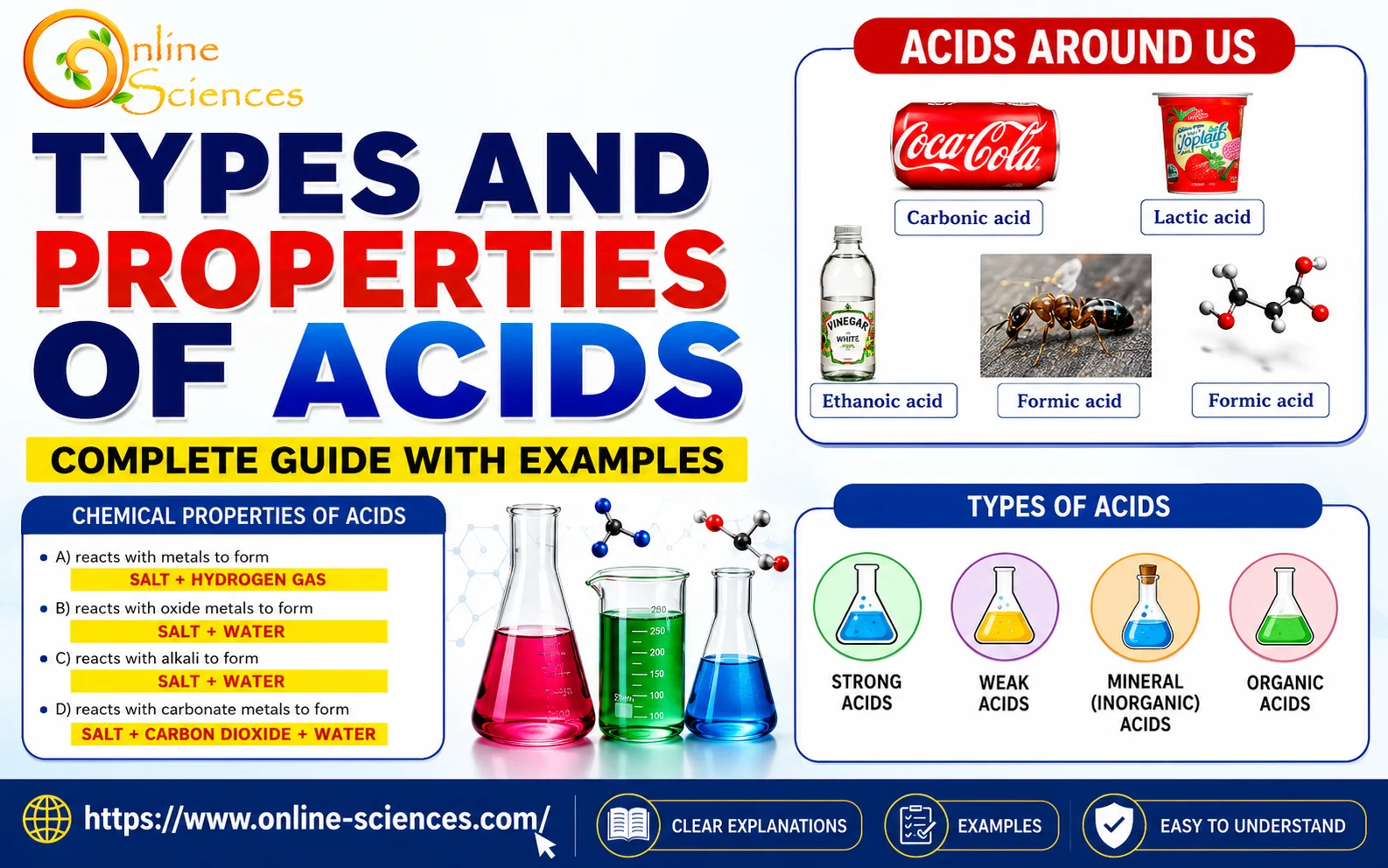
Acids are substances that release hydrogen ions (H⁺) when dissolved in water. They can be classified according to their strength, origin, and the number of hydrogen ions they can donate.
1. Strong Acids
Strong acids completely ionize in water, producing a high concentration of hydrogen ions.
Examples:
- Hydrochloric acid (HCl).
- Sulfuric acid (H₂SO₄).
- Nitric acid (HNO₃).
- Perchloric acid (HClO₄).
Characteristics
- Highly reactive.
- Excellent conductors of electricity.
- Very low pH (typically below 3).
- Highly corrosive.
2. Weak Acids
Weak acids only partially ionize in water, producing fewer hydrogen ions.
Examples:
- Acetic acid (CH₃COOH).
- Carbonic acid (H₂CO₃).
- Citric acid.
- Formic acid.
Characteristics
- Less reactive than strong acids.
- Higher pH than strong acids.
- Safer for many biological applications.
3. Mineral (Inorganic) Acids
These acids are derived from inorganic compounds and are commonly used in industrial processes.
Examples
- Hydrochloric acid.
- Sulfuric acid.
- Nitric acid.
- Phosphoric acid.
Uses
- Metal cleaning.
- Fertilizer production.
- Chemical manufacturing.
- Petroleum refining.
4. Organic Acids
Organic acids contain carbon and occur naturally in plants, fruits, and living organisms.
Examples
- Acetic acid.
- Citric acid.
- Lactic acid.
- Oxalic acid.
- Tartaric acid.
Uses
- Food preservation.
- Beverage production.
- Pharmaceuticals.
- Cosmetics.
Physical Properties of Acids
Most acids share several physical characteristics.
- Sour taste (never taste chemicals in a laboratory).
- Turn blue litmus paper red.
- Conduct electricity in aqueous solutions.
- Usually colorless liquids, although some are solids.
- Have a pH below 7.
- Can be highly corrosive depending on concentration.
Chemical Properties of Acids
Acids undergo several characteristic chemical reactions.
1. Reaction with Metals
Acids react with reactive metals to produce hydrogen gas.
Example: Zn + 2HCl → ZnCl₂ + H₂
2. Reaction with Bases
Acids react with bases to form salt and water.
Example: HCl + NaOH → NaCl + H₂O , This reaction is called neutralization.
3. Reaction with Carbonates
Acids react with carbonates to produce: Carbon dioxide, Water, and salt
Example: CaCO₃ + 2HCl → CaCl₂ + CO₂ + H₂O
4. Reaction with Metal Oxides
Acids react with metal oxides to form salt and water.
Example: CuO + 2HCl → CuCl₂ + H₂O
Common Properties Shared by Most Acids
- Donate hydrogen ions (H⁺).
- Have pH values less than 7.
- React with metals.
- React with carbonates.
- Neutralize bases.
- Change indicators such as litmus paper.
- Conduct electricity when dissolved in water.
Everyday Uses of Acids
Acids are widely used in daily life and industry.
- Food preservation.
- Soft drinks.
- Car batteries.
- Fertilizer manufacturing.
- Pharmaceutical production.
- Cleaning products.
- Leather processing.
- Textile manufacturing.
- Metal treatment.
- Laboratory experiments.
Safety Precautions When Handling Acids
- Wear safety goggles and gloves.
- Always add acid to water, never water to acid.
- Store acids in labeled containers.
- Keep acids away from children.
- Work in a well-ventilated area.
- Neutralize spills using appropriate materials.
- Avoid direct skin or eye contact.
Frequently Asked Questions (FAQ) about acids
1. What are the main types of acids?
The main types include strong acids, weak acids, mineral (inorganic) acids, and organic acids.
2. What are the basic properties of acids?
Acids have a pH below 7, release hydrogen ions in water, turn blue litmus paper red, react with metals and bases, and conduct electricity in solution.
3. What is the difference between strong and weak acids?
Strong acids completely dissociate in water, while weak acids only partially dissociate, producing fewer hydrogen ions.
4. Why do acids conduct electricity?
Because dissolved acids produce free-moving ions that carry electric current.
5. What happens when an acid reacts with a base?
An acid reacts with a base in a neutralization reaction to produce salt and water.
6. Are all acids dangerous?
No. Many weak acids, such as citric acid and acetic acid, are commonly found in foods, while concentrated strong acids require careful handling due to their corrosive nature.
7. Which acid is found in vinegar?
Vinegar primarily contains acetic acid.
8. Why do acids turn blue litmus paper red?
Acids increase the concentration of hydrogen ions, causing acid-base indicators like blue litmus paper to change color.
9. What are some common uses of acids?
Acids are used in food processing, medicine, batteries, fertilizer production, cleaning agents, metal processing, and laboratory research.
10. What is the pH range of acids?
Acids generally have a pH lower than 7, with strong acids having values close to 0 and weak acids having values closer to 7.
You can subscribe to Science Online on YouTube from this link: Science Online
Types of compounds, Properties of Acids, Bases (alkalis), Oxides and Salts
Classification of Acids according to its strength (degree of ionization), Its source & Basicity