
Lasers in Communication & Fiber Optics 2026: Powerful Benefits, Uses & Advantages
Lasers in communication have become a fundamental technology behind modern high-speed networks, enabling huge amounts of information to travel rapidly through fiber optic cables. From internet connections and mobile networks to data centers, cloud computing, and long-distance telecommunications, laser-based optical communication provides high bandwidth, low signal loss, and reliable data transmission. In 2026, advances in optical technologies continue to support the growing demand for faster and more efficient digital communication.
Lasers in Communication
Lasers in communication
Laser communications systems are wireless connections through the atmosphere. The light speed is the fastest at which anything can travel, so laser communications and laser sensing are important in mortar defense and other crucial aerospace and defense applications.
Lasers are able to see through dense foliage, and they can allow for space communication from distances measured in millions of miles. We use lasers everywhere, such as in military systems, avionics, and submarines.
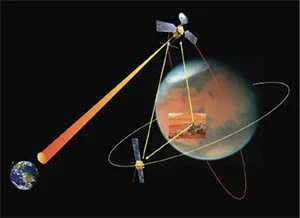
Communication in space
Laser communications are better than radio, as light wavelengths are packed much more tightly than sound waves, and they transmit more information per second with a stronger signal. Lasers are used in communication with optical fibers instead of telephone cables.
We send and receive data, video, and other information using lasers to encode and transmit the data at rates 10 to 100 times faster than radio. A laser is a very intense, concentrated, highly parallel, and monochromatic beam, and coherence is a very important property of a laser.
Lasers have been used in communications for years, and we can transfer information by lasers every day, such as reading CDs and DVDs, and we can scan bar codes at checkout lines or tap the fiber optic backbone of the phone or internet services.
Laser communications systems can be easily deployed because they are inexpensive and small. They have low power, and they do not require any radio interference studies. Data exchange is relatively easy to combine with accurate range metering, which is essential in many applications.
Laser communications are solutions to satisfy increasing bandwidth needs. Laser communication systems can transmit speeds of up to a gigabit per second. Laser communications assure much faster data traffic at lower power consumption, smaller geometrical size, and much higher immunity to eavesdropping.
Advantages of fiber optic cables
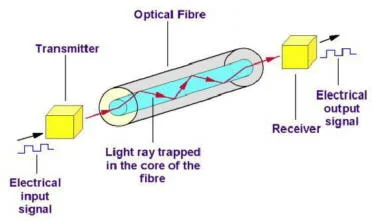
Optical fiber
The optical fibers are thin strands of glass through which a laser beam can travel for several miles, and laser amplifiers are needed only every six or seven miles to strengthen the light signal.
One of the advantages of laser fiber optics is that several fibers can be wrapped inside one cable, and each cable contains many laser beams, each carrying billions of bits of information.
Multiple signals can be sent with high quality and low loss by light propagating along the fibers, and lasers are more nearly monochromatic, which allows the pulse shape to be maintained better over long distances.
The optical signals are sent at infrared wavelengths of 1.3 to 1.6 micrometers, where the glass fibers are most transparent.
Importance of Lasers in Communication
A laser produces a highly focused and coherent beam of light that can be used to transmit information. In an optical communication system, a laser converts electrical data into optical signals. These light signals travel through an optical fiber and are converted back into electrical information at the receiving end.
One of the most important advantages of lasers is their ability to operate at specific wavelengths that are suitable for transmission through optical fibers. Common telecommunications wavelengths include around 1310 nm and 1550 nm, where optical fibers can provide relatively low attenuation and efficient long-distance transmission.
Lasers can also transmit information at extremely high frequencies. This allows communication systems to carry enormous quantities of data simultaneously using techniques such as wavelength-division multiplexing (WDM). Multiple optical signals at different wavelengths can travel through the same fiber, dramatically increasing network capacity.
Laser communication is particularly important for internet backbones, submarine communication cables, telecommunications networks, cloud infrastructure, and data centers. As demand for artificial intelligence, video streaming, cloud services, and real-time applications grows, high-capacity optical communication becomes increasingly important.
Advantages of Fiber Optic Cables
Fiber optic cables transmit information using pulses of light through very thin strands of glass or plastic. They offer several important advantages compared with traditional copper communication cables.
- Very high bandwidth: Fiber optics can carry enormous amounts of information, making them ideal for high-speed internet and telecommunications.
- Low signal loss: Optical fibers can transmit signals over long distances with relatively low attenuation, reducing the need for frequent signal regeneration.
- High data transmission speed: Light-based transmission enables extremely fast communication and supports modern broadband networks.
- Immunity to electromagnetic interference: Unlike copper cables, optical fibers are not affected by electromagnetic interference, making them useful in environments containing electrical equipment.
- Lightweight and compact: Fiber optic cables can carry large amounts of data while remaining relatively thin and lightweight.
- Improved security: Optical fibers do not radiate electromagnetic signals in the same way as copper cables, making unauthorized interception more difficult, although fiber networks are not automatically immune to security threats.
- Long-distance communication: Fiber optics are widely used for terrestrial networks and submarine cables because they can support high-capacity communication across very long distances.
Lasers and the Future of Optical Communication
The combination of semiconductor lasers and fiber optics forms the foundation of many modern communication networks. Continued development of optical transceivers, photonic technologies, multiplexing systems, and advanced fiber networks is helping communication infrastructure handle rapidly increasing data requirements.
As artificial intelligence, cloud computing, connected devices, and high-resolution digital services continue to expand, lasers and fiber optics will remain essential technologies for fast, reliable, and high-capacity communication in 2026 and beyond.
FAQ about Lasers in Communication
1. Why are lasers important in communication?
Lasers provide highly focused, high-frequency light signals that can carry large amounts of information through optical fibers at high speeds.
2. How do lasers transmit information through fiber optics?
A laser converts electrical data into pulses or modulated optical signals. The light travels through the fiber and is converted back into electrical information at the receiving end.
3. What are the main advantages of fiber optic cables?
The main advantages include very high bandwidth, fast transmission, low signal loss, electromagnetic interference immunity, lightweight construction, and suitability for long-distance communication.
4. Why are fiber optics better than copper for high-speed networks?
Fiber optics can provide much greater bandwidth and are resistant to electromagnetic interference, making them particularly suitable for high-capacity communication.
5. Where are laser and fiber optic communication systems used?
They are used in internet backbones, telecommunications, data centers, cloud infrastructure, submarine cables, and high-speed broadband networks.
6. What wavelengths are commonly used in fiber optic communication?
Communication systems commonly operate around the 1310 nm and 1550 nm wavelength regions, depending on the application and fiber system.
7. Will lasers remain important for communication in the future?
Yes. Increasing demand for data capacity from AI, cloud computing, streaming, and connected devices continues to drive the need for advanced optical communication technologies.
You can follow Science Online on YouTube from this link: Science Online
Nanotechnology in Medicine: 7 Powerful Uses & Amazing Benefits for Modern Healthcare
🔥 Tesla Bot Gen 4 UPDATE 5000 Tasks As HOMEMAKER & Surgeon! Elon Musk SHOCKED Inside Optimus! 🤯
The applications, advantages & possible harmful effects of Nanotechnology
Applications on the total reflection of light (Optical fibers, Reflecting prism & Mirage)
The advantages and disadvantages of optical fiber cables over electrical cables
Laser rays properties, Spontaneous emission and stimulated emission
Nuclear submarines (Nuclear Powered Ships) advantages and disadvantages