Modern Management of Malignant Liver Tumors: How Interventional Radiology, TACE, and Radiofrequency Ablation Are Transforming Treatment – By Dr. Mahmoud Abdelaziz Ghalab
Malignant liver tumors are among the most serious conditions affecting patients across the Arab world. Early diagnosis and choosing the right treatment strategy can significantly improve outcomes and quality of life. As an interventional radiology consultant, I help patients manage liver cancer using the latest minimally invasive techniques that target the tumor with precision and minimal side effects.
Malignant Liver Tumors
In this article, I explain the types of malignant liver tumors and how modern interventional radiology—particularly arterial chemoembolization and radiofrequency ablation—offers safe and highly effective alternatives to open surgery.
What Are Malignant Liver Tumors?
Malignant liver tumors include:
- Hepatocellular Carcinoma (HCC): The most common primary liver cancer, usually caused by chronic viral hepatitis (B or C), cirrhosis, or fatty liver disease.
- Cholangiocarcinoma is a cancer that begins in the bile ducts inside the liver.
- Secondary (Metastatic) Liver Tumors. Tumors that spread from other organs, such as the colon, breast, or pancreas. These are actually more common than primary liver cancer.
Regardless of the type, early detection allows more treatment options and better long-term survival.
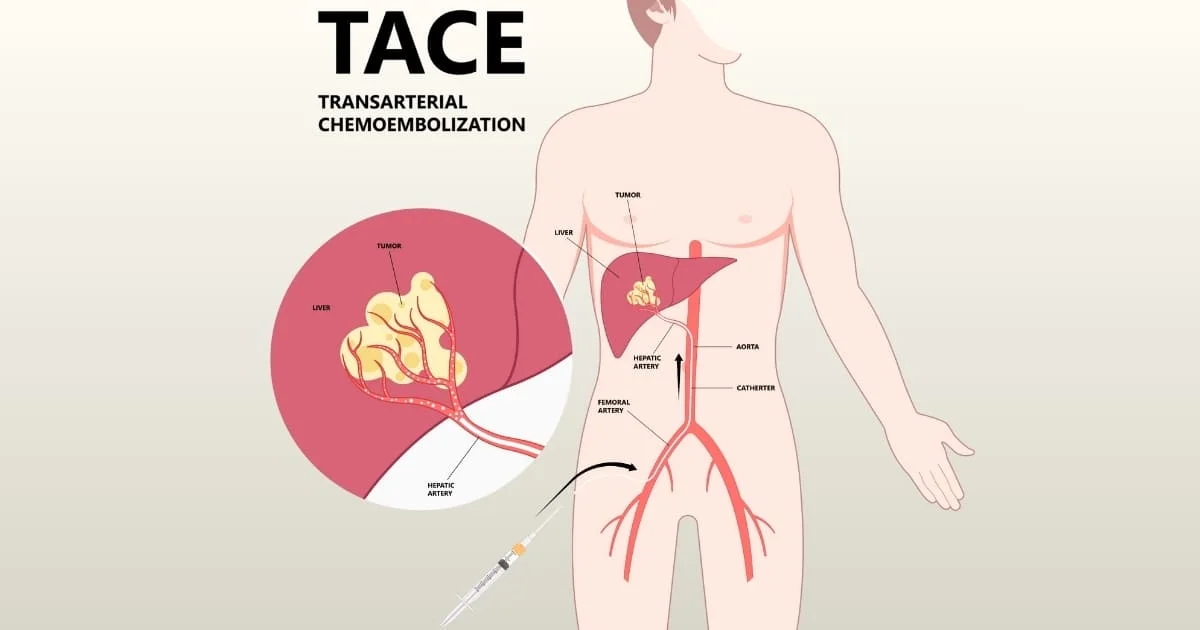
Chemoembolization for Liver Tumor Treatment with Dr. Mahmoud Ghalab
How Interventional Radiology Helps Treat Liver Cancer
Interventional radiology offers targeted, minimally invasive treatments performed through a tiny skin puncture rather than major surgery, These techniques allow patients to recover faster, avoid general anesthesia in most cases, and preserve healthy liver tissue.
The most important treatments include:
1. Arterial Chemoembolization (TACE)
A cornerstone in liver cancer therapy.
What it is: A specialized procedure in which chemotherapy is delivered directly into the artery feeding the tumor. Then, tiny particles are injected to block the tumor’s blood supply, causing it to shrink.
Why it’s effective:
- Concentrates chemotherapy inside the tumor with minimal effect on the rest of the body
- Starves the cancer cells by cutting their blood supply.
- Can be repeated safely when needed.
- Suitable for patients who cannot undergo surgery or have multiple small tumors.
Recovery: Patients usually stay one night in the hospital and return to normal activities within a few days.
2. Radiofrequency Ablation (RFA)
Destroying tumors with heat.
What it is: A needle is guided into the tumor using ultrasound or CT. Controlled heat is then applied to destroy the cancer cells.
Advantages of Radiofrequency Ablation
- Excellent for small tumors (up to 3–4 cm).
- High success rate comparable to surgery for early-stage cancer.
- Minimally invasive, outpatient, or short-stay procedure
- Quick recovery and minimal complications.
- RFA is often recommended for early liver cancer or for patients who cannot undergo surgical removal due to age or liver cirrhosis.
3. Microwave Ablation (MWA)
A newer alternative to RFA.It uses electromagnetic waves to heat and destroy larger tumors faster and more effectively than radiofrequency in some cases.

Dr. Mahmoud Ghalab is the best interventional radiology consultant in Egypt
Why Dr. Mahmoud Abdelaziz Ghalab Is Considered the Best Interventional Radiology Consultant in Egypt, Alexandria, and the Arab World
Over the years, I have treated thousands of liver cancer cases using the latest international protocols. Patients choose me for several reasons:
- Extensive experience in interventional oncology and complex liver tumors.
- Precision-guided techniques using advanced imaging systems.
- A patient-centered approach, focusing on comfort, safety, and long-term results.
- Excellent success rates in TACE, RFA, and microwave ablation.
- Leadership in training and clinical development in Egypt and the region.
- My mission is to provide every patient—especially older adults and those with chronic liver disease—with safe, effective therapeutic options without the risks of major surgery.
How to Choose the Best Doctor for Liver Cancer Treatment
When selecting a liver cancer specialist, make sure the doctor has:
- Strong experience in interventional oncology.
- Access to high-technology imaging and equipment.
- A full team experienced in liver disease, oncology, and anesthesia.
- A reputation for successful outcomes and patient care.
- Clear communication and personalized treatment planning.
- Liver cancer treatment requires precision—so choosing a trusted interventional radiologist is essential.
Treatment Cost in Egypt and the Arab World
Costs depend on the type of procedure, tumor size, and hospital equipment, but on average:
- Arterial Chemoembolization (TACE): 25,000 – 45,000 EGP per session.
- Radiofrequency Ablation (RFA):18,000 – 35,000 EGP.
- Microwave Ablation (MWA): 20,000 – 40,000 EGP.
Prices may vary based on hospital grade, supplies used, and follow-up care. Compared to Europe or the Gulf, Egypt offers world-class interventional radiology at significantly lower rates.
Final Advice to Patients
Early diagnosis saves lives. If you have chronic hepatitis B or C, cirrhosis, or a family history of liver cancer, regular follow-up and abdominal ultrasound every six months is essential.
Modern interventional radiology now offers highly effective, minimally invasive treatments that improve survival and quality of life—even in advanced cases. For many patients, liver cancer is no longer a hopeless diagnosis—the right doctor and the right technique make all the difference.
For contact with Dr. Mahmoud Ghalab’s clinic or to book an appointment:
217 El Horreya Road (Abou Qir Street), El Ibrahimia/Alexandria/Egypt
GIG – Global Interventional Radiology Center
You can subscribe to Science Online on YouTube from this link: Science Online
Common procedures of Interventional Radiology and the best Interventional Radiologists
Interventional radiology types, Robotic endovascular systems advantages and disadvantages
Cone beam CT vs. Fan beam CT, CBCT advantages, disadvantages and uses
Magnetic Resonance Imaging (MRI) uses, advantages and disadvantages
Computed Tomography (CT) types, uses, advantages and disadvantages
Artificial intelligence in radiology decision support systems, Medical Imaging and Healthcare
Enlarged prostate symptoms, Prostatic artery embolization (PAE) importance and risks
Hepatic Artery Embolization, Importance and risks of Embolization therapy for Liver cancer
Thyroid nodules, Thyroid Fine Needle Aspiration Biopsy importance and risks
Uterine fibroid embolization risks, importance and Minimally invasive procedure specialists
Advantages and Disadvantages of Using Interventional Radiology in Pain Management