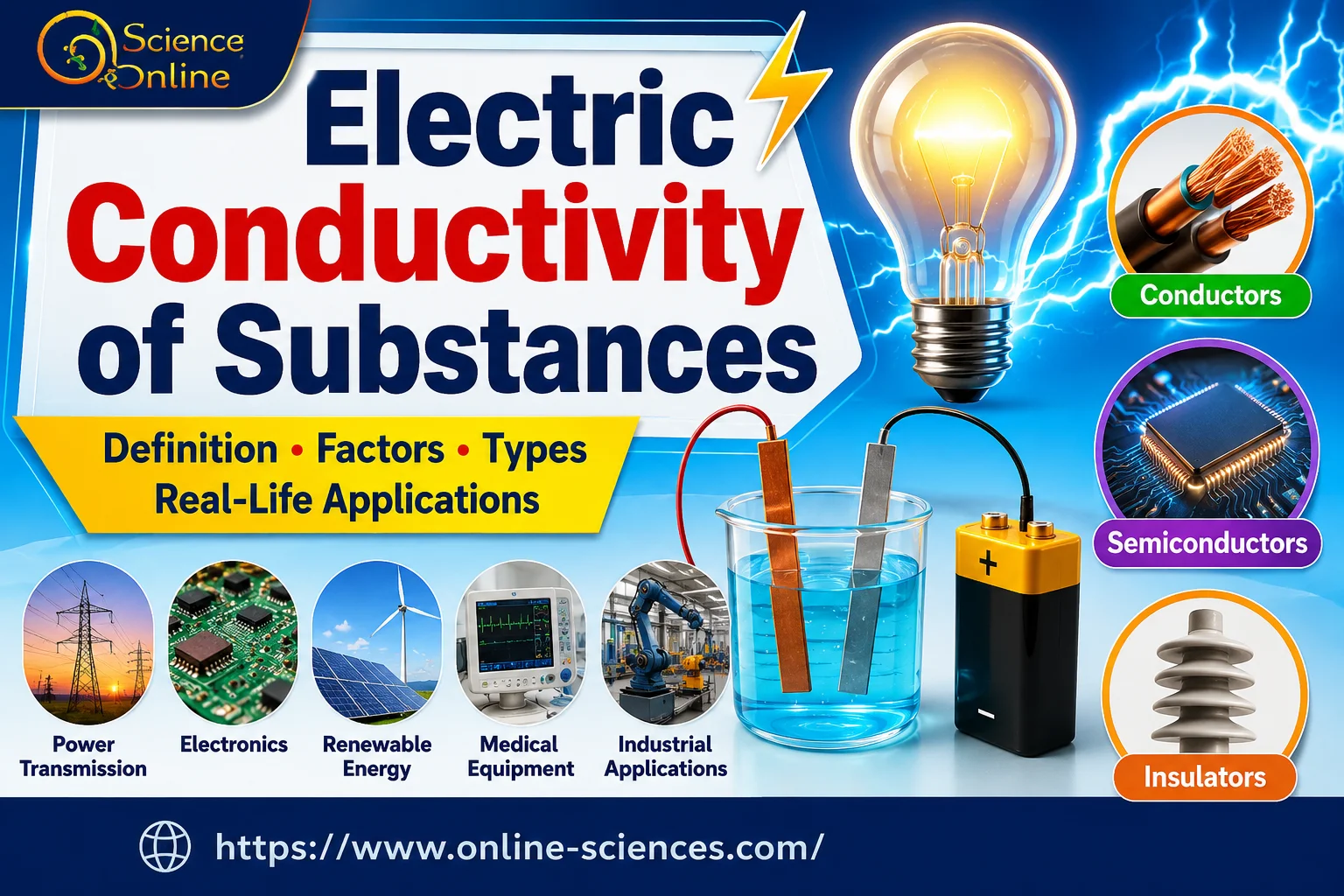
Electric Conductivity of Substances: 10 Essential Types, Factors, and Amazing Real-Life Applications
Electric conductivity of substances is one of the most important physical properties that determines how easily electricity flows through a material. Conductors, semiconductors, and insulators all play essential roles in modern technology, from household wiring and smartphones to renewable energy systems and medical equipment. Understanding electrical conductivity helps explain why different materials behave differently in electrical circuits and industrial applications.
Electric Conductivity of Substances
Electric conductivity
Substances can be classified according to electrical conductivity into good and bad conductors of electricity. The electrical conductivity is the ability of a material to conduct an electric current (a flow of electrons).
Good conductors of electricity are substances that allow electricity to flow through, such as acidic solutions, alkaline solutions, some salt solutions, and metals such as iron, copper, and aluminum. The electrical conductor is a substance in which the electrical charges (the electrons) move easily from atom to atom with the application of voltage.
Good conductors of electricity can carry a complete electric current in end-to-end voltage, such as copper, gold, silver, aluminum, etc., and some conductors are not metals. Carbon is the best example.

Good conductors and bad conductors
Bad conductors of electricity are substances that do not allow electricity to flow through, such as gases, some solutions, such as the solution of hydrogen chloride in benzene, sugary solutions, some solid elements, such as sulphur, phosphorus, wood, and plastic.
The insulators are materials that are bad conductors of electricity; they have high resistivity because they have no charge carriers or free electrons to carry the electric current, such as glass and rubber.
Some materials cannot be classified as either conductors or insulators. They are the semiconductors. They are the materials that conduct an electric current, but they do very poorly. The semiconductors act as good conductors under some conditions and poor conductors under other conditions, such as silicon, germanium, and various metal oxides.
The semiconductors are materials whose conductivities lie between those of conductors and insulators. When the temperature of a semiconductor is increased, its resistivity decreases or its conductivity increases. At higher temperatures, the semiconductors conduct better, so the semiconductor has a negative temperature coefficient of resistance.
Life application on electric conductivity
The electric wires (or the cables) are made of copper or aluminium and covered by a plastic layer because both copper and aluminum are good conductors of electricity, while the plastic is a bad conductor of electricity. The screwdrivers are made of steel iron, while their handles are made of wood or plastic because steel iron is a good conductor of electricity, but wood and plastic are bad conductors of electricity.
What is Electric Conductivity?
Electric conductivity is the ability of a material to allow an electric current to pass through it. It depends on the presence of free electrons or charged ions that can move easily when an electric field is applied. The SI unit of electrical conductivity is Siemens per meter (S/m). Materials with high conductivity allow current to flow easily, while materials with low conductivity resist the flow of electricity.
Types of Materials Based on Electrical Conductivity
1. Conductors
Conductors allow electricity to flow with very little resistance because they contain many free electrons.
Examples include:
- Copper.
- Silver.
- Gold.
- Aluminum.
- Iron.
Applications
- Electrical wiring.
- Power transmission lines.
- Electronic circuits.
- Electric motors.
- Transformers.
2. Semiconductors
Semiconductors have conductivity between conductors and insulators. Their conductivity can be controlled by temperature or impurities (doping).
Examples include:
- Silicon.
- Germanium.
- Gallium arsenide.
Applications
- Computer processors.
- Solar panels.
- LEDs.
- Transistors.
- Integrated circuits.
3. Insulators
Insulators do not allow electric current to pass easily because they have very few free electrons.
Examples include:
- Rubber.
- Glass.
- Plastic.
- Ceramic.
- Dry wood.
Applications
- Cable insulation.
- Electrical safety equipment.
- High-voltage transmission systems.
- Electronic device casings.
Factors Affecting Electrical Conductivity
Several factors influence electrical conductivity:
- Temperature: Metals generally become less conductive as temperature increases. Semiconductors become more conductive at higher temperatures.
- Material Composition: Different elements have different numbers of free electrons, affecting conductivity.
- Impurities: Small amounts of impurities can significantly increase or decrease conductivity.
- Crystal Structure: The arrangement of atoms influences electron movement.
- Moisture: Water containing dissolved salts conducts electricity much better than pure water.
Electrical Conductivity of Common Materials
- Silver: Excellent.
- Copper: Excellent.
- Gold: Very High.
- Aluminum: High.
- Iron: Moderate.
- Silicon: Medium (Semiconductor).
- Glass: Very Low.
- Rubber: Extremely Low.
- Plastic: Extremely Low.
- Air: Very Poor.
Real-Life Applications of Electrical Conductivity
- Household Electrical Wiring: Copper and aluminum wires safely deliver electricity throughout homes and buildings.
- Electronics: Smartphones, computers, and televisions rely on semiconductor materials to process electrical signals.
- Electric Vehicles: Battery connections, motors, and charging systems require highly conductive materials for maximum efficiency.
- Renewable Energy: Solar panels use semiconductors to convert sunlight into electrical energy. Wind turbines also use conductive materials in generators and power transmission systems.
- Medical Equipment: Electrical conductivity is essential in ECG machines, MRI systems, Defibrillators, and Medical sensors.
- The aerospace industry; Aircraft and spacecraft use lightweight conductive materials for electrical systems and communication networks.
- Industrial Manufacturing: Factories depend on conductive metals for automated machinery, robotics, and power distribution.
- Telecommunications: Copper cables, antennas, and electronic circuits enable the internet, television, and mobile communication.
Advantages of High Electrical Conductivity
- Efficient power transmission.
- Lower energy losses.
- Reduced heat generation.
- Better electronic performance.
- Improved reliability.
- Longer equipment lifespan.
- Disadvantages of Poor Conductivity.
- Increased electrical resistance.
- Greater energy loss.
- Excessive heating.
- Reduced device efficiency.
- Higher operating costs.
Importance of Electrical Conductivity in Everyday Life
Electrical conductivity supports nearly every aspect of modern living. It powers homes, transportation systems, communication devices, healthcare equipment, manufacturing industries, and renewable energy technologies. Without conductive materials, modern electronics and electrical infrastructure would not function efficiently.
Conclusion
Electrical conductivity is a fundamental property that determines how effectively materials transmit electric current. Conductors such as copper and silver are essential for power transmission, semiconductors drive the electronics industry, and insulators provide electrical safety. Understanding electrical conductivity helps engineers, scientists, and students design safer, more efficient electrical systems and develop innovative technologies for the future.
FAQs about Electric Conductivity of Substances
1. What is electrical conductivity?
Electrical conductivity is the ability of a material to allow an electric current to flow through it.
2. Which metal has the highest electrical conductivity?
Silver has the highest electrical conductivity among all metals.
3. Why is copper widely used instead of silver?
Copper offers excellent conductivity at a much lower cost, making it the preferred material for electrical wiring.
4. Why are plastics used around electrical wires?
Plastic is an excellent electrical insulator that prevents electric shocks and short circuits.
5. Is pure water a good conductor of electricity?
No. Pure water is a poor conductor because it contains very few ions. Water containing dissolved salts conducts electricity much better.
6. What are semiconductors?
Semiconductors are materials whose electrical conductivity lies between conductors and insulators and can be controlled through doping or temperature.
7. How does temperature affect conductivity?
Higher temperatures generally decrease the conductivity of metals but increase the conductivity of semiconductors.
8. Why is electrical conductivity important?
It enables efficient power transmission, electronic device operation, industrial automation, renewable energy systems, and countless everyday technologies.
You can subscribe to Science Online on YouTube from this link: Science Online
Electrical current, Potential difference, Electric resistance and Ohm’s law