Blood circulation in circulatory system, major and minor circulation, What happens if circulation is disrupted?
Blood circulation is the path of the blood throughout the body. It can be divided into two small circulations, which are the minor (pulmonary) blood circulation and the major (systemic) blood circulation.
Human Circulatory System
The minor (pulmonary) blood circulation is the blood circulation between the heart and the two lungs. The major (systemic) blood circulation is the blood circulation between the heart and all the parts of the body.
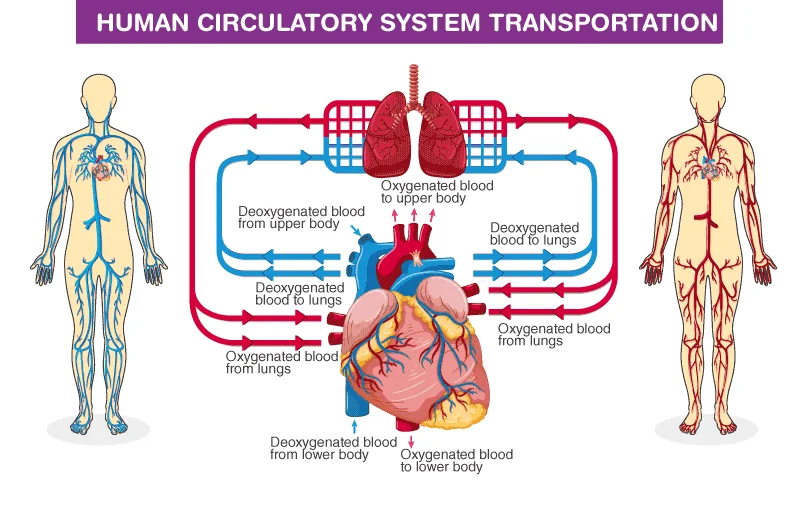
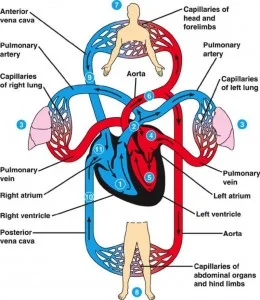
The blood carrying carbon dioxide gas reaches from all the body parts to the right atrium through the two large veins, which are the superior and the inferior venae cavae.
Human Circulatory System
The blood flows to the right ventricle through a valve. The right ventricle contracts, pumping the blood into the two lungs through the pulmonary artery. Inside the two lungs, carbon dioxide gas is exchanged with oxygen gas.
The blood rich in oxygen (which comes from the two lungs) returns to the left atrium through the pulmonary veins, and then it flows to the ventricle through a valve.
The left ventricle contracts, pumping the blood rich in oxygen to all the body cells through a large artery called the aorta.
The wall of the left ventricle is thicker than the right ventricle, as the left ventricle pumps blood to all the body cells, while the right ventricle pumps blood to the two lungs only.
When the right atrium receives blood rich in carbon dioxide from the venae cavae, the left atrium receives blood rich in oxygen from the pulmonary veins.
When the right ventricle pumps blood to the lungs, the left ventricle pumps blood to all the body cells.
Blood circulation in the human body
FAQ about Blood Circulation
1. What is blood circulation?
Blood circulation is the continuous movement of blood throughout the body via the circulatory system. It delivers oxygen and nutrients to cells and removes waste products.
2. What are the types of blood circulation?
There are two main types:
- Major circulation (systemic circulation).
- Minor circulation (pulmonary circulation).
3. What is major (systemic) circulation?
Major circulation is the flow of oxygenated blood from the heart to all parts of the body and back again. It starts from the left side of the heart and supplies tissues with oxygen and nutrients.
4. What is minor (pulmonary) circulation?
Minor circulation is the movement of blood between the heart and the lungs. It carries deoxygenated blood to the lungs for oxygenation and returns oxygen-rich blood to the heart.
5. What is the pathway of major circulation?
- Blood leaves the heart through the aorta.
- Travels to body organs and tissues.
- Delivers oxygen and nutrients.
- Returns to the heart through the veins.
6. What is the pathway of minor circulation?
- Blood leaves the heart through the pulmonary artery.
- Goes to the lungs.
- Releases carbon dioxide and picks up oxygen.
- Returns to the heart through the pulmonary veins.
7. What is the main difference between major and minor circulation?
- Major circulation: Heart → Body → Heart
- Minor circulation: Heart → Lungs → Heart
8. Why is pulmonary circulation important?
Pulmonary circulation ensures that blood gets oxygen from the lungs and removes carbon dioxide, which is essential for survival.
9. Why is systemic circulation important?
Systemic circulation supplies all body cells with oxygen and nutrients and removes metabolic wastes.
10. How do the heart and blood vessels work together in circulation?
The heart acts as a pump, while blood vessels (arteries, veins, and capillaries) transport blood throughout the body.
11. What role does oxygen play in circulation?
Oxygen is transported by blood to cells for energy production and is essential for cellular respiration.
12. What happens if circulation is disrupted?
Poor circulation can lead to:
- Oxygen deficiency in tissues.
- Organ damage.
- Serious health conditions.
13. How is blood kept moving in one direction?
Valves in the heart and veins ensure that blood flows in one direction and prevent backflow.
Blood circulation consists of major (systemic) and minor (pulmonary) pathways that work together to keep the body alive by delivering oxygen and nutrients and removing wastes efficiently.
You can follow Science Online on YouTube from this link: Science Online