12 Powerful and Essential Facts About the Juxtaglomerular Apparatus Structure, Function, and Autoregulation of Glomerular Filtration Rate
Juxtaglomerular apparatus structure, function, and autoregulation of glomerular filtration rate are fundamental concepts in renal physiology. The juxtaglomerular apparatus (JGA) is a specialized structure located where the distal convoluted tubule comes into contact with the afferent and efferent arterioles of the same nephron. This remarkable system helps regulate blood pressure, maintain electrolyte balance, and ensure that the glomerular filtration rate (GFR) remains relatively stable despite fluctuations in systemic blood pressure.
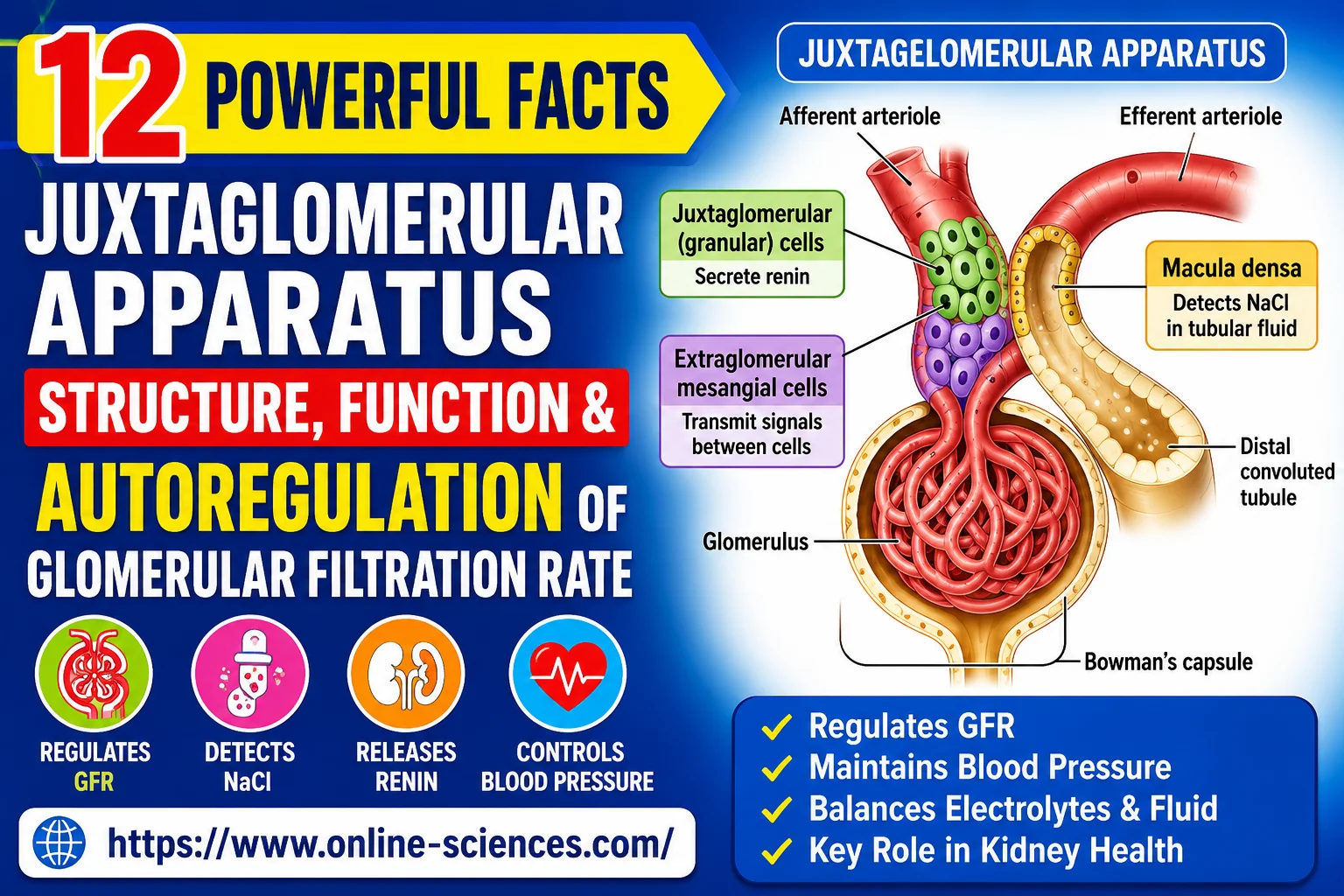
Juxtaglomerular Apparatus
Juxtaglomerular Apparatus
The juxtaglomerular apparatus is located at the vascular pole of each glomerulus, where the afferent and efferent arterioles come in close contact with the initial part of the distal convoluted tubule. It is made up of tubular and vascular elements of the nephron, which interact to control the systemic blood pressure and the rate of glomerular filtration (and hence the rate of urine formation).
What is the Juxtaglomerular Apparatus?
The juxtaglomerular apparatus is a microscopic structure in the kidney that acts as a monitoring and regulatory center. It detects changes in sodium chloride concentration and blood pressure, then adjusts renal blood flow and renin release to maintain homeostasis.
Histological components of juxtaglomerular apparatus
A. Juxtaglomerular (JG) cells
They are modified smooth muscle fibers in the tunica media of the afferent arteriole (occasionally in the efferent arteriole) as it enters the vascular pole of the glomerulus. Here, the internal elastic lamina of the afferent arteriole is lacking. They have the histological features of protein-secreting cells with prominent secretory granules.
Function:
- Synthesis and release of protein hormone, renin.
- Secretion of erythropoietin.
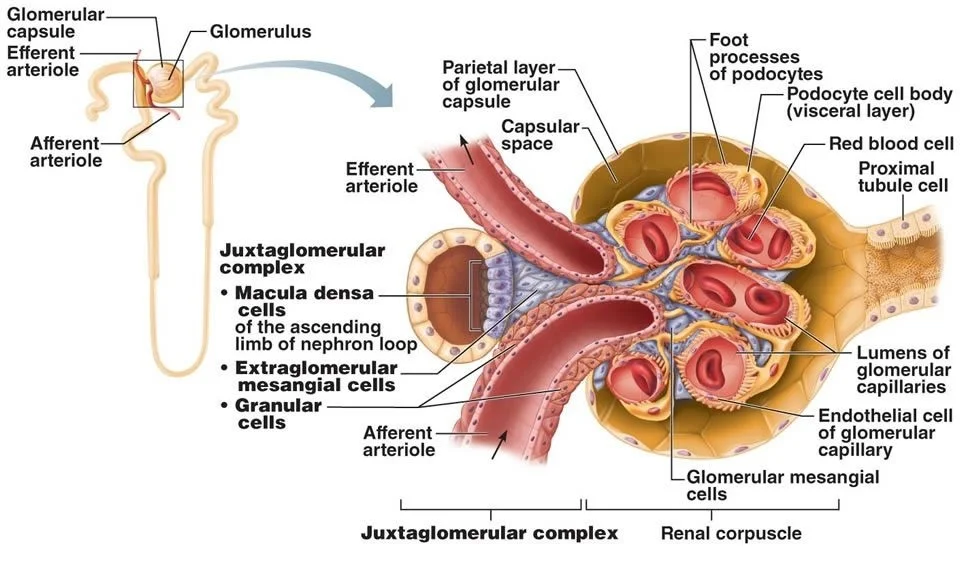
Juxtaglomerular apparatus
B. Macula densa cells
They are modified cells of the distal tubule that come in close contact with the afferent arteriole at the vascular pole of the glomerulus of its nephron.
Histological features: They differ from the ordinary cells of the distal tubule in the following:
- They are closely-packed columnar cells with crowded and superimposed nuclei.
- Thus, the cells appear as a dense spot (hence the name “macula densa”).
- The cytoplasm shows few mitochondria with no basal membrane infoldings.
- The apical cell membrane has numerous microvilli and a central cilium that acts as a sensor for sodium ion concentration in tubular fluid and for blood pressure changes.
- They extend a basal process to contact the juxtaglomerular cells by gap junctions to signal their release of the renin hormone.
Function: osmoreceptors.
C. Extra-glomerular mesangial cells (polar cushion cells or lacis cells)
These are groups of cells occupying the angle between the afferent and efferent arterioles.
Histological features: They are small cells with a lace-like network of cytoplasmic processes that contact the macula densa, the juxtaglomerular, and the intraglomerular mesangial cells by gap junctions for intercellular signaling.
Function: support and coordination function.
Functions of Juxtaglomerular Apparatus
- Endocrine function: (JG) cells secrete renin, which leads to the formation of angiotensin Il that regulates the ABP. Moreover, the JG cells secrete the erythropoietin hormone that stimulates erythropoiesis.
- Autoregulation of GFR and RBF.
Histological structure of the collecting ducts
The last part of each nephron is the short connecting tubule, which carries the filtrate from the distal convoluted tubules into the cortical collecting ducts. These are located in the medullary rays and continue down through the medullary pyramid as medullary collecting ducts.
Many medullary collecting ducts join to form larger straight papillary ducts of Bellini, which open in the area cribrosa at the apex of the renal papilla. The lining cells are less eosinophilic with distinct intercellular boundaries. Two types of lining cells can be distinguished:
- Principal cells (light cells); they are the majority, present in all parts of collecting ducts. They are pale with few mitochondria and their function is ADH-regulated water facultative reabsorption.
- Intercalated cells (dark cells): they are few, found mainly in the smaller collecting ducts. They have dark cytoplasm with numerous mitochondria and their function is regulation of acid-base balance in the tubular fluid.
Autoregulation of glomerular filtration rate (Tubulo-glomerular Feedback)
Although a change in the mean arterial pressure causes a marked change in urinary output, this pressure can decrease to 75 mmHg or increase to 160 mmHg and cause very little change in glomerular filtration rate; this is called autoregulation of glomerular filtration rate.
It is important because the nephron requires an optimal rate of glomerular filtration to perform its function. As little as a 5 percent increase or decrease in glomerular filtration can have serious effects in causing either excess fluid loss in urine or too little excretion of the necessary waste products.
Mechanism of autoregulation of glomerular filtration rate
The mechanism of autoregulation is uncertain. It is intrinsic to the kidneys since autoregulation can be demonstrated in transplanted, denervated kidneys. There are two hypotheses (theories) trying to explain the autoregulation of the glomerular filtration rate and renal blood flow.
One mechanism responds to changes in arterial pressure (Myogenic mechanism) and another that responds to changes in [NaCI] tubular fluid (Tubuloglomerular feedback mechanism), Both regulate the tone of the afferent arteriole.
Myogenic hypothesis
The afferent arterioles have the inherent ability to respond to changes in vessel circumference by contracting or relaxing (a myogenic response). The myogenic hypothesis attributes the increase in renal vascular resistance that accompanies an increase in systemic arterial pressure to contraction of the afferent arteriolar smooth muscle in response to stretch.
On the other hand, a decrease in systemic arterial pressure decreases the stretch on the afferent arteriolar smooth muscle and leads to afferent arteriolar dilatation.
Juxtaglomerular hypothesis (Tubuloglomerular feedback (TGF) mechanism)
The juxtaglomerular hypothesis mechanism involves a feedback loop in which a change in GFR leads to alteration in the concentration of NaCl in tubular fluid, which is sensed by the macula densa of the juxtaglomerular apparatus and converted into signals that affect the afferent arteriolar resistance and thus the GFR.
A) In case of hypertension
- An increase in arterial pressure leads to an increase in glomerular capillary pressure, RPF, and GFR.
- The increase in GFR leads to increased delivery of Na+ Cl− to the macula densa cells of the juxtaglomerular apparatus.
- Macula densa cells will release a vasoconstrictor substance (e.g., ATP, adenosine & thromboxane), which causes vasoconstriction of the afferent arteriole and normalization of GFR.
The net effect is an increase in the afferent arteriolar resistance and a decrease in GFR, thereby counteracting the initial increase in GFR.
B) In case of hypotension
The Juxtaglomerular hypothesis attributes autoregulation of the glomerular filtration rate to two special feedback mechanisms:
- An afferent arteriolar vasodilator feedback mechanism.
- An efferent arteriolar vasoconstrictor feedback mechanism.
1. The afferent arteriolar vasodilator feedback mechanism
- A decrease in arterial pressure leads to a decrease in glomerular capillary pressure, RPF, and GFR
- The decrease in GTR leads to decreased delivery of Na+ Cl− to the macula densa cells of the juxtaglomerular apparatus.
- Macula densa cells will decrease the release of vasoconstrictor substances. The fall in ATP and adenosine, with the release of vasodilator substances like (NO) results in afferent arteriolar vasodilatation.
This increases the rate of blood flow into the glomerulus and increases the glomerular pressure, with a subsequent increase of GFR back to normal.
2. The efferent arteriolar vasoconstrictor feedback mechanism
- The low concentration of Na+ and Cl− ions causes the JG cells to secrete renin from their granules.
- The renin causes the formation of angiotensin II.
- Angiotensin Il constricts the efferent arterioles, which causes the pressure in the glomerulus to rise.
- The increased pressure then causes the glomerular filtration rate to return back to normal.
Autoregulation of renal blood flow
The renal blood flow is relatively constant between the limits of 70 and 160 mmHg mean arterial pressure. It is mainly the afferent arteriolar feedback mechanism that causes this renal blood flow autoregulation.
If the mean arterial pressure is increased:
- RBF and GFR are increased.
- The concentration of sodium and chloride ions at the macula densa increases, which causes afferent arteriolar constriction that decreases the GFR and RBF back to normal.
If the mean arterial pressure is decreased:
- When the renal blood flow becomes too little, the glomerular pressure falls, and the GFR also decreases.
- The concentration of sodium and chloride ions decreases at the maculadensa, which causes afferent arteriolar dilatation that increases the renal blood flow and GFR back toward normal despite the low arterial pressure.
When the arterial pressure remains low for more than 10 to 20 minutes: Blood flow autoregulation disappears. Instead, the efferent arteriolar vasoconstrictor mechanism becomes more potent, which decreases the renal blood flow. This allows the glomerular filtration rate to remain almost constant, but the marked decrease in blood flow through the kidney helps to return the arterial pressure back to normal.
Key Facts About Juxtaglomerular Apparatus and GFR Regulation
- The JGA is located where the distal tubule contacts the glomerular arterioles.
- Macula densa cells monitor sodium chloride concentration.
- Juxtaglomerular cells produce renin.
- The JGA regulates blood pressure through RAAS.
- Autoregulation keeps GFR relatively constant.
- The myogenic mechanism responds to arterial pressure changes.
- Tubuloglomerular feedback depends on macula densa signaling.
- Renin release increases during low renal perfusion.
- Angiotensin II helps maintain filtration pressure.
- The JGA contributes to electrolyte balance.
- Kidney diseases may impair autoregulation.
- Many antihypertensive drugs target pathways controlled by the JGA.
Frequently Asked Questions about the juxtaglomerular apparatus
1. What is the juxtaglomerular apparatus?
The juxtaglomerular apparatus is a specialized renal structure composed of the macula densa, juxtaglomerular cells, and extraglomerular mesangial cells that regulate GFR and blood pressure.
2. What is the main function of the juxtaglomerular apparatus?
Its primary functions are regulating renin secretion, maintaining glomerular filtration rate, and controlling blood pressure.
3. What are the components of the juxtaglomerular apparatus?
The three main components are the macula densa, juxtaglomerular (granular) cells, and extraglomerular mesangial cells.
4. How does the macula densa regulate GFR?
The macula densa senses sodium chloride levels in tubular fluid and adjusts afferent arteriolar resistance and renin release to stabilize filtration.
5. What is tubuloglomerular feedback?
Tubuloglomerular feedback is a regulatory mechanism in which the macula densa modifies arteriolar tone and renin secretion according to sodium chloride delivery.
6. Why is renin important?
Renin activates the renin-angiotensin-aldosterone system, which regulates blood pressure, sodium balance, and kidney perfusion.
7. What is the myogenic mechanism?
It is an intrinsic response of the afferent arteriole that constricts when stretched and dilates when pressure falls, helping maintain stable GFR.
8. How does the juxtaglomerular apparatus affect blood pressure?
By controlling renin release and activating RAAS, the JGA influences vascular resistance and fluid retention, thereby regulating blood pressure.
9. Can damage to the JGA affect kidney function?
Yes. Dysfunction of the JGA can impair renal autoregulation, alter renin secretion, and contribute to hypertension or kidney disease.
10. Why is the juxtaglomerular apparatus important in medicine?
It is a major target for drugs used to treat hypertension, heart failure, and chronic kidney disease.
Components of the Juxtaglomerular Apparatus
- Macula Densa: The macula densa consists of specialized epithelial cells located in the distal convoluted tubule. These cells detect changes in sodium chloride concentration in the tubular fluid and send signals to neighboring cells.
- Juxtaglomerular (Granular) Cells: These modified smooth muscle cells are found mainly in the wall of the afferent arteriole. They synthesize and release renin when blood pressure falls or when stimulated by the macula densa.
- Extraglomerular Mesangial Cells: Also called Lacis cells, these cells are located between the afferent and efferent arterioles and the macula densa. They facilitate communication within the juxtaglomerular apparatus.
Functions of the Juxtaglomerular Apparatus
- Regulation of Renin Secretion: The JGA controls the release of renin, which initiates the renin-angiotensin-aldosterone system (RAAS). This system helps regulate blood pressure and fluid balance.
- Maintenance of Glomerular Filtration Rate: The JGA ensures that GFR remains relatively constant despite variations in arterial pressure.
- Electrolyte and Fluid Balance: By monitoring sodium chloride levels, the JGA contributes to the regulation of water and electrolyte homeostasis.
- Blood Pressure Regulation: Through renin release and activation of RAAS, the JGA plays a crucial role in controlling systemic blood pressure.
Autoregulation of Glomerular Filtration Rate
Autoregulation refers to the kidney‘s ability to maintain a stable GFR across a wide range of blood pressures.
Myogenic Mechanism
When blood pressure increases, the afferent arteriole stretches and contracts automatically. This vasoconstriction reduces blood flow into the glomerulus, preventing excessive filtration. Conversely, when blood pressure decreases, the arteriole relaxes, allowing more blood to enter the glomerulus and helping preserve GFR.
Tubuloglomerular Feedback Mechanism
The tubuloglomerular feedback mechanism is mediated by the macula densa.
High Sodium Chloride Delivery:
- Macula densa detects increased NaCl concentration.
- Signals cause constriction of the afferent arteriole.
- Glomerular pressure decreases.
- GFR returns toward normal levels.
Low Sodium Chloride Delivery:
- Macula densa detects reduced NaCl concentration.
- Juxtaglomerular cells release renin.
- Angiotensin II production increases.
- Efferent arteriole constricts preferentially.
- GFR is maintained.
Clinical Importance of the Juxtaglomerular Apparatus
Disorders affecting the JGA can lead to:
- Hypertension.
- Chronic kidney disease.
- Abnormal renin secretion.
- Fluid and electrolyte imbalances.
- Impaired renal autoregulation.
Understanding the JGA is essential for interpreting the actions of medications such as ACE inhibitors, angiotensin receptor blockers (ARBs), and renin inhibitors.
Conclusion
The juxtaglomerular apparatus structure, function, and autoregulation of glomerular filtration rate represent one of the most powerful and essential regulatory systems in human physiology. Through the coordinated actions of the macula densa, juxtaglomerular cells, and mesangial cells, the kidneys maintain stable filtration, regulate blood pressure, and preserve fluid and electrolyte balance. Understanding these mechanisms is crucial for students, healthcare professionals, and anyone interested in kidney physiology.
You can subscribe to Science Online on YouTube from this link: Science Online
Urine formation, Factors affecting Glomerular filtration rate, Tubular reabsorption & secretion
Histological structure of kidneys, Uriniferous tubules & Types of nephrons
Suprarenal glands (adrenal glands) anatomy, structure & Effect of Deficiency of Catecholamines
Functions of Kidneys, Role of Kidney in glucose homeostasis, Lipid & protein metabolism
Urinary system structure, function, anatomy, organs, Blood supply & Importance of renal fascia