15 Essential Facts About Lanthanides and Actinides (Inner Transition Metals) in the Modern Periodic Table
Lanthanides and Actinides (Inner Transition Metals) are two unique series of elements located at the bottom of the modern periodic table. They possess remarkable chemical, physical, and electronic properties that make them essential in nuclear energy, electronics, magnets, lasers, medicine, and advanced materials. Understanding these inner transition metals helps explain many important applications in science, technology, and industry.
Lanthanides and Actinides
Lanthanides and actinides
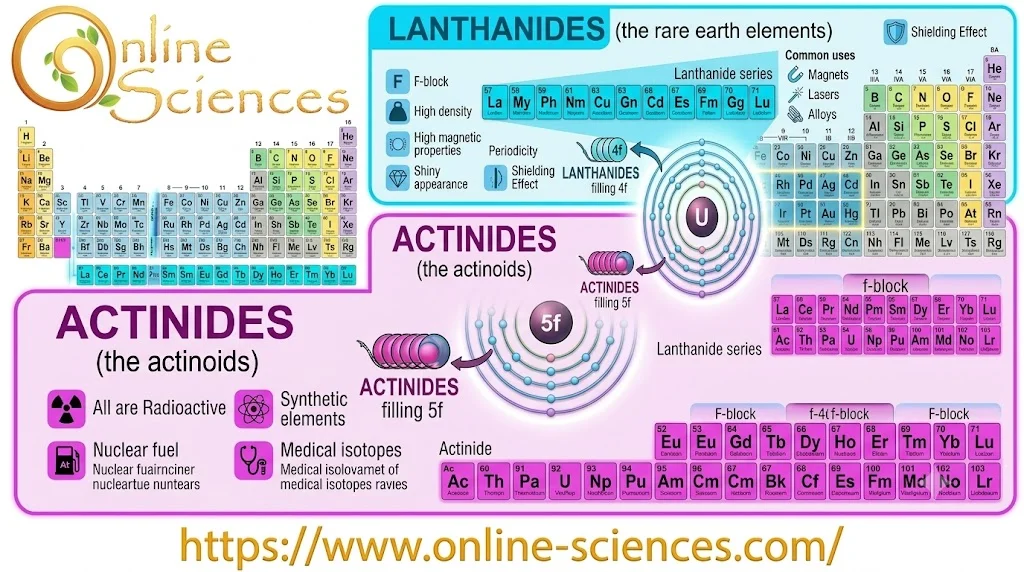
Lanthanides and actinides are located below the modern periodic table. They consist of two rows. They are known as the f-block elements because they have valence electrons in the f-shell, Lanthanides elements can be found naturally on Earth, and only one element of them is radioactive.
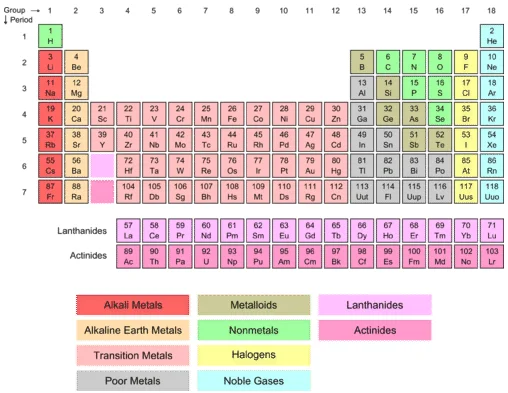
Lanthanides are 14 elements with atomic numbers 57 (Lanthanum, La) to 71 (Lutetium, Lu), and Actinides are 14 elements with atomic numbers from 89 (Actinium, Ac) to 103 (Lawrencium, Lr).
Lanthanides and Actinides belong to the periods 6 and 7, respectively, and between groups 3 and 4, and they are set off below the main portion of the table. All of the actinides are radioactive, and some of them are not found in nature. There are two series of elements that belong to the inner transition metals in the periodic table. They are placed separately at the bottom of the table to maintain its structure.
Lanthanides are an important group of elements. Most of the lanthanides are formed when uranium and plutonium undergo nuclear reactions. Lanthanides are the elements produced as the 4f sublevel is filled with electrons, and the actinides are formed while filling the 5f sublevel.
Lanthanides and Actinides in the periodic table
Actinides are the elements found in the second period of the f-block, and these elements fill up the 5 f sublevel. Lanthanides are the rare earth elements found in the first period of the f– block, and these elements fill up the 4 f sublevel.
1. Lanthanides (Rare Earth Elements)
The atomic Numbers: 57 (Lanthanum) to 71 (Lutetium), Location: Period 6, f-block
General Properties:
- Silvery-white metals.
- High melting and boiling points.
- Typically trivalent (+3 oxidation state).
- Exhibit similar chemical properties due to the lanthanide contraction.
- Used in electronics, magnets, lasers, and catalysts.
Elements:
- Lanthanum (La)
- Cerium (Ce)
- Praseodymium (Pr)
- Neodymium (Nd)
- Promethium (Pm) (radioactive, rarest)
- Samarium (Sm)
- Europium (Eu)
- Gadolinium (Gd)
- Terbium (Tb)
- Dysprosium (Dy)
- Holmium (Ho)
- Erbium (Er)
- Thulium (Tm)
- Ytterbium (Yb)
- Lutetium (Lu)
2. Actinides
The atomic Numbers: 89 (Actinium) to 103 (Lawrencium), Location: Period 7, f-block
General Properties:
- All are radioactive.
- Can have multiple oxidation states (+3 to +6).
- Some are highly reactive and toxic.
- Used in nuclear reactors, weapons, and medical applications.
Elements:
- Actinium (Ac)
- Thorium (Th)
- Protactinium (Pa)
- Uranium (U) (used in nuclear fuel)
- Neptunium (Np)
- Plutonium (Pu) (used in nuclear weapons & reactors)
- Americium (Am) (used in smoke detectors)
- Curium (Cm)
- Berkelium (Bk)
- Californium (Cf) (used as a neutron source)
- Einsteinium (Es)
- Fermium (Fm)
- Mendelevium (Md)
- Nobelium (No)
- Lawrencium (Lr)
Uses of lanthanides and actinides
- Oxides of lanthanides and actinides are used in the glass industry for polishing and making colored glass for goggles and television screens.
- Due to the paramagnetic and ferromagnetic nature of the lanthanides and actinides, they are used in magnetic and electronic devices.
- Mixed oxides of the lanthanides are used in petroleum cracking, and ceric sulphate is well-known as an oxidizing agent that is used in the volumetric analysis.
- Lanthanides and actinides do not find any use in their pure state, so they are used in the production of alloys of steel to improve the strength and workability of the steel.
Importance of Lanthanides and Actinides
Lanthanides and actinides play a crucial role in modern technology, medicine, energy, and research. Their unique properties make them valuable in various applications.
1. Importance of Lanthanides
Lanthanides, also known as rare earth elements, are widely used in high-tech industries due to their magnetic, optical, and catalytic properties.
Major Applications:
Electronics & Communication:
- Used in smartphones, laptops, and televisions (e.g., phosphors in screens).
- Neodymium (Nd) and Dysprosium (Dy) are used in high-strength magnets for electric motors and speakers.
Renewable Energy:
- Neodymium and Samarium are essential for making powerful magnets used in wind turbines.
- Lanthanum (La) and Cerium (Ce) improve battery performance in hybrid and electric vehicles (EVs).
Optics & Lasers:
- Ytterbium (Yb) and Erbium (Er) are used in fiber-optic communication systems.
- Holmium (Ho) and Thulium (Tm) are used in laser surgery.
Catalysts & Chemical Processing:
- Cerium (Ce) is used in catalytic converters in vehicles to reduce pollution.
- Lanthanum (La) is used in refining petroleum and manufacturing optical glass.
Medical Applications:
Gadolinium (Gd) is used in MRI contrast agents for better imaging.
2. Importance of Actinides
Actinides, especially uranium and plutonium, are critical for nuclear energy and medical advancements.
Major Applications:
Nuclear Energy & Power Generation:
- Uranium-235 (U-235) is used as a fuel in nuclear reactors to generate electricity.
- Plutonium-239 (Pu-239) is used in nuclear power and weapons.
- Thorium (Th) is being researched as an alternative nuclear fuel.
Medical Uses:
- Americium-241 (Am-241) is used in smoke detectors and as a radiation source in medical imaging.
- Californium-252 (Cf-252) is used in cancer treatment and neutron radiography.
Scientific Research:
- Actinides are used in space exploration for radioisotope thermoelectric generators (RTGs), providing power for spacecraft like Voyager and Curiosity Rover.
- They help in studying nuclear reactions and particle physics.
Military & Defense:
- Plutonium (Pu) is a key component in nuclear weapons.
- Uranium (U) is used in armor-piercing ammunition and naval reactors.
Lanthanides are crucial for technology, renewable energy, and medical imaging, while actinides are vital for nuclear energy, space exploration, and medical treatments. Their applications make them essential elements for scientific progress and daily life.
FAQ About Lanthanides and Actinides
1. What are lanthanides and actinides?
Lanthanides and actinides are collectively known as the inner transition metals or f-block elements of the modern periodic table. They are displayed in two separate rows beneath the main body of the periodic table to save space.
2. Where are lanthanides and actinides located in the periodic table?
They are placed below the main periodic table.
- Lanthanides: Atomic numbers 57–71 (Lanthanum to Lutetium).
- Actinides: Atomic numbers 89–103 (Actinium to Lawrencium).
3. Why are they called inner transition metals?
They are called inner transition metals because their valence electrons are added to the inner f-orbitals, unlike transition metals, whose electrons fill the d-orbitals.
4. What is the electronic configuration of lanthanides?
Their general electronic configuration is: [Xe] 4f¹–4f¹⁴ 5d⁰–¹ 6s², The gradual filling of the 4f orbital gives lanthanides their distinctive chemical behavior.
5. What is the electronic configuration of actinides?
Their general electronic configuration is: [Rn] 5f¹–5f¹⁴ 6d⁰–¹ 7s², The filling of the 5f orbital results in more complex chemistry compared to lanthanides.
6. What are the main characteristics of lanthanides?
Lanthanides generally:
- Are soft, silvery metals.
- Have high melting points.
- Conduct heat and electricity well.
- Are chemically reactive.
- Usually exhibit a +3 oxidation state.
- Show magnetic and luminescent properties.
7. What are the main characteristics of actinides?
Actinides are characterized by:
- High radioactivity.
- Multiple oxidation states.
- High density.
- Strong electropositive nature.
- Ability to form complex compounds.
- Many synthetic elements.
8. Why are most actinides radioactive?
Their large atomic nuclei are unstable, causing them to undergo radioactive decay by emitting alpha, beta, or gamma radiation until they reach more stable forms.
9. What is lanthanide contraction?
Lanthanide contraction refers to the gradual decrease in atomic and ionic radii across the lanthanide series due to poor shielding by 4f electrons, increasing the effective nuclear charge.
10. Why is lanthanide contraction important?
It affects:
- Atomic size.
- Ionic radius.
- Chemical reactivity.
- Density.
- Separation of rare earth elements.
- Similarity between transition metals.
11. What are the major uses of lanthanides?
Lanthanides are widely used in:
- Powerful permanent magnets.
- Hybrid and electric vehicle motors.
- Catalytic converters.
- LED lighting.
- Lasers.
- Medical imaging.
- Optical glass.
- Rechargeable batteries.
- Wind turbines.
12. What are the major uses of actinides?
Actinides have important applications in:
- Nuclear reactors.
- Nuclear weapons.
- Spacecraft power systems.
- Smoke detectors.
- Scientific research.
- Cancer treatment.
- Industrial radiography.
13. How do lanthanides differ from actinides?
Lanthanides and actinides are both inner transition metals located in the f-block of the modern periodic table, but they differ significantly in their electronic structure, chemical behavior, radioactivity, and practical applications. Lanthanides consist of elements with atomic numbers 57 to 71, where electrons gradually fill the 4f orbitals. In contrast, actinides include elements with atomic numbers 89 to 103, with electrons filling the 5f orbitals, resulting in more complex chemical properties.
One of the most important differences is radioactivity. Most lanthanides are stable or only weakly radioactive, with promethium being the only naturally radioactive lanthanide. In comparison, all actinides are radioactive, and many have highly unstable nuclei that undergo continuous radioactive decay. This makes actinides valuable for nuclear energy and scientific research but also requires careful handling due to radiation hazards.
Their oxidation states also differ considerably. Lanthanides predominantly exhibit a +3 oxidation state, giving them relatively similar chemical behavior across the series. Actinides, however, can display a wide range of oxidation states, commonly from +3 to +6 and sometimes even higher, making their chemistry much more diverse and complex.
Another key difference lies in chemical reactivity. The 4f electrons of lanthanides are well shielded and participate only slightly in chemical bonding, leading to fairly uniform chemical properties. In contrast, the 5f electrons of actinides are less shielded and are more involved in bonding, resulting in greater reactivity and the formation of a wider variety of compounds.
The applications of these two groups also reflect their unique properties. Lanthanides are widely used in powerful permanent magnets, lasers, LED lighting, rechargeable batteries, catalysts, optical devices, and electric vehicles. Actinides are primarily used in nuclear reactors, nuclear fuel, spacecraft power systems, smoke detectors, industrial radiography, and cancer treatment, where their radioactive properties are essential.
Overall, while both lanthanides and actinides belong to the inner transition metals, lanthanides are generally stable, less reactive metals with limited oxidation states, whereas actinides are highly radioactive, chemically more reactive, and exhibit multiple oxidation states, making them indispensable in nuclear science and advanced technologies.
14. Why are lanthanides called rare earth elements?
Although called “rare,” many lanthanides are relatively abundant in Earth’s crust. They are termed rare earth elements because they were originally discovered in uncommon mineral deposits and are difficult to separate due to their similar chemical properties.
15. Why are lanthanides and actinides important?
These elements are vital because they support many modern technologies, including renewable energy systems, advanced electronics, telecommunications, aerospace engineering, nuclear power generation, defense technologies, and medical diagnostics and therapies.
16. Which lanthanide is naturally radioactive?
Promethium (Pm) is the only naturally occurring lanthanide that is entirely radioactive.
17. Which actinides occur naturally?
Naturally occurring actinides include:
- Actinium.
- Thorium.
- Protactinium.
- Uranium.
Small amounts of neptunium and plutonium can also occur naturally through radioactive decay processes.
18. Why are actinides more chemically complex than lanthanides?
The 5f electrons in actinides are less shielded and participate more readily in chemical bonding than the 4f electrons of lanthanides, leading to greater variability in oxidation states and more diverse chemical behavior.
19. Why are the lanthanide and actinide series separated from the main periodic table?
They are placed below the main table primarily to maintain the compact structure and readability of the periodic table. Including them in the main body would make the table much wider and less practical.
20. Why are inner transition metals important for future technologies?
Inner transition metals are essential for the development of clean energy technologies, electric vehicles, high-performance magnets, quantum materials, advanced medical equipment, nuclear energy systems, aerospace engineering, robotics, and next-generation electronic devices.
You can subscribe to Science Online on YouTube from this link: Science Online