
12 Powerful Facts About Properties of Noble (Inert) Gases, Features and Applications
Properties of Noble (Inert) Gases make them among the most fascinating elements in the periodic table. These gases are known for their exceptional stability, low chemical reactivity, and wide range of practical applications. From helium-filled balloons and neon advertising signs to argon welding shields and xenon headlights, noble gases play a vital role in modern technology, medicine, scientific research, and industrial manufacturing. Understanding their unique features helps explain why they are indispensable in many fields of science and everyday life.
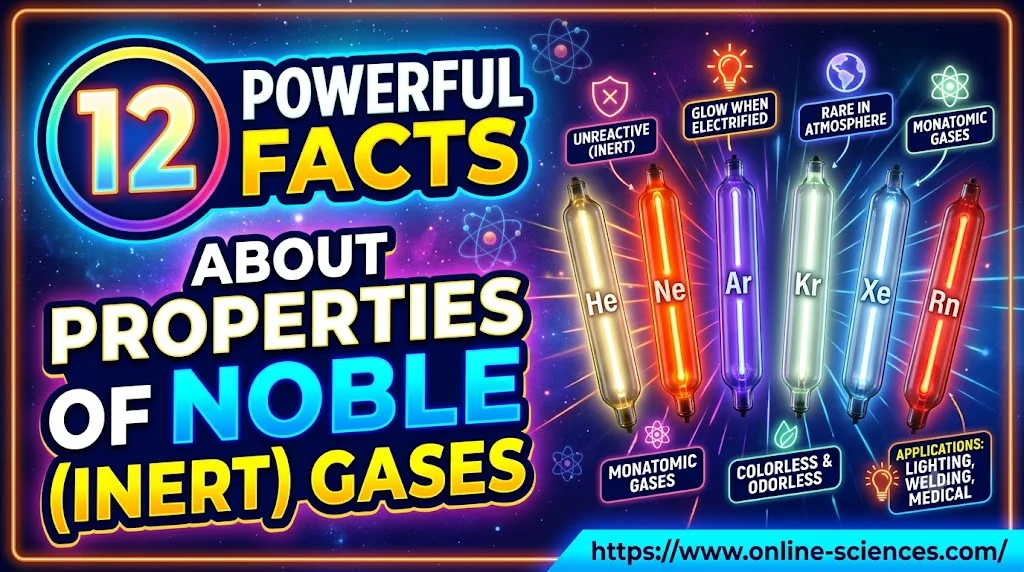
Properties of Noble (Inert) Gases
Inert gases
Inert gases are the elements in which the outermost electron shells are completely filled with electrons, so they don’t participate in any chemical combination under ordinary conditions.
Noble gases do not form positive or negative ions in ordinary conditions. The elements of the atoms with which all the shells completely filled are called inert gases, noble gases, or rare gases.
Helium (He), Neon (Ne), Argon (Ar), Krypton (Kr), Xenon (Xe), and Radon (Rn) are inert gases. The noble gases make a group of chemical elements with similar properties under standard conditions.
The noble gases are odorless, colorless, monoatomic gases with very low chemical reactivity, and each molecule consists of a single atom (monoatomic).
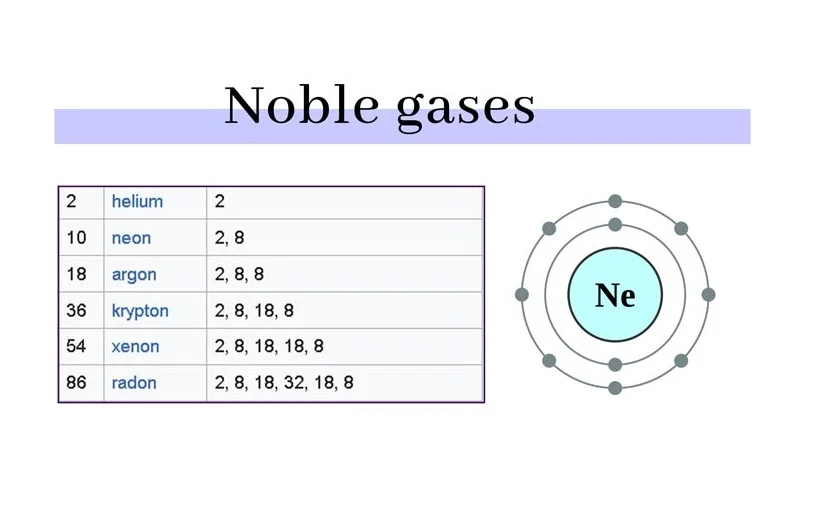
Noble gases
The noble gases have weak interatomic forces; they have low melting and boiling points, and they are all monoatomic gases under standard conditions. The noble gases are located in the far-right column of the periodic table; they are in group (0) or group (18).
They have a valence of zero; their atoms cannot combine with other elements to form compounds. The noble gases have full valence electron shells; they are stable and do not tend to form chemical bonds.
Noble gases are commonly used in lighting because of their lack of chemical reactivity, and they glow in distinctive colours when they are used inside gas-discharge lamps such as neon lights.
Some noble gases have direct application in medicine, and the noble gases are used in the excimer lasers.
Properties of inert gases
Inert gases are also known as noble gases. They are a group of elements in Group 18 of the periodic table. Noble gases include helium (He), neon (Ne), argon (Ar), krypton (Kr), xenon (Xe), and radon (Rn). These gases share several unique properties:
Physical Properties
- Colorless, Odorless, and Tasteless: Noble gases are colorless, odorless, and tasteless in their natural state.
- Low Boiling and Melting Points: Inert gases exist as gases under standard conditions due to weak intermolecular forces.
- Monatomic: Inert gases exist as single atoms rather than molecules, making them unique among elements.
- Low Density: Inert gases are lighter than many other gases, especially helium, which is the lightest after hydrogen.
- Non-Flammability: Inert gases are non-flammable, as they do not readily react with other substances.
Chemical Properties
- High Stability: Noble gases have full outer electron shells (except helium, which has a full 1s shell with two electrons), making them chemically stable and unreactive under normal conditions.
- Low Reactivity: Their lack of chemical reactivity is due to their complete valence electron configuration. However, under extreme conditions, some (like xenon and krypton) can form compounds, especially with highly electronegative elements like fluorine and oxygen.
- Insolubility: Inert gases have low solubility in water, though solubility increases slightly with molecular weight.
- Nonpolar Nature: Noble gases are nonpolar because they are monoatomic and do not form bonds under typical conditions.
Applications of Inert Gases
- Helium is used in balloons and cryogenics, and it is used as a coolant in nuclear reactors.
- Neon is known for its use in neon lights and signs.
- Argon is widely used in welding and as an inert gas shield in industrial processes.
- Krypton and Xenon are used in lighting (e.g., flash photography, high-intensity lamps) and as anesthetics in some cases.
- Radon: Though radioactive, it has applications in cancer treatment and radiotherapy.
Frequently Asked Questions (FAQ) About Noble (Inert) Gases
1. What are noble gases?
Noble gases are a group of chemical elements found in Group 18 of the periodic table. They include helium, neon, argon, krypton, xenon, and radon. These gases are known for their extremely low chemical reactivity.
2. Why are noble gases called inert gases?
Noble gases are called inert gases because their outermost electron shells are completely filled, making them very stable and unlikely to gain, lose, or share electrons in chemical reactions.
3. What are the main properties of noble gases?
Noble gases are colorless, odorless, tasteless, non-flammable, and monatomic under normal conditions. They also have low boiling and melting points and exhibit very low chemical reactivity.
4. Why do noble gases have low reactivity?
Their valence electron shells are completely filled, giving them a stable electronic configuration. As a result, they rarely form chemical compounds.
5. Which noble gas is the lightest?
Helium is the lightest noble gas and the second-lightest element in the periodic table after hydrogen.
6. Do noble gases form compounds?
Although noble gases are generally inert, heavier noble gases such as xenon and krypton can form compounds under specific laboratory conditions.
7. Why are noble gases used in lighting?
Noble gases emit characteristic colors when an electric current passes through them. This property makes them useful in neon signs, fluorescent lamps, and other lighting applications.
8. What is the most abundant noble gas in Earth’s atmosphere?
Argon is the most abundant noble gas in Earth’s atmosphere, making up approximately 0.93% of the air.
9. How is helium used in everyday life?
Helium is commonly used in balloons, airships, cryogenic cooling systems, and medical imaging equipment such as MRI scanners.
10. What are the industrial applications of noble gases?
Noble gases are used in welding, lighting, lasers, semiconductor manufacturing, medical equipment, space exploration, and scientific research.
11. Why is argon used in welding?
Argon provides an inert atmosphere around the welding area, preventing oxidation and contamination of molten metals.
12. What makes xenon useful in high-intensity lamps?
Xenon produces a bright white light and is used in car headlights, projectors, camera flashes, and specialized lighting systems.
13. Is radon safe?
Radon is radioactive and can be hazardous to human health if it accumulates in enclosed spaces. Long-term exposure may increase the risk of lung cancer.
14. How are noble gases obtained?
Most noble gases are extracted from liquefied air through fractional distillation, while helium is often obtained from natural gas deposits.
15. Why are noble gases important in scientific research?
Their chemical stability makes them useful for creating controlled environments, conducting experiments, and studying physical and chemical processes without unwanted reactions.
16. What color does neon produce in signs?
Neon produces a bright reddish-orange glow, making it popular for advertising signs and decorative lighting.
17. Why is helium important in cryogenics?
Helium remains liquid at extremely low temperatures and is widely used for cooling superconducting magnets and advanced scientific instruments.
18. Can noble gases conduct electricity?
Under normal conditions, they are poor conductors, but they can conduct electricity when ionized in electric discharge tubes.
19. Which noble gas is used in lasers?
Helium, neon, krypton, and xenon are commonly used in various types of lasers for scientific, medical, and industrial purposes.
20. What are the advantages of using inert gases in industry?
Inert gases help prevent chemical reactions, corrosion, contamination, and oxidation, improving product quality and safety in industrial processes.
Features of Noble (Inert) Gases
- Complete outer electron shell.
- Extremely low chemical reactivity.
- Colorless, odorless, and tasteless.
- Exist as single atoms (monatomic gases).
- Low boiling and melting points.
- Non-flammable and chemically stable.
- Poorly soluble in water.
- Produce characteristic colors when electrically excited.
- Useful in creating protective atmospheres.
- Important in medical, industrial, and scientific applications.
Applications of Noble (Inert) Gases
- Helium: Used in balloons, airships, MRI cooling systems, deep-sea diving mixtures, and cryogenic research.
- Neon: Used in advertising signs, decorative lighting, high-voltage indicators, and display technologies.
- Argon: Used in welding, metal production, incandescent light bulbs, and semiconductor manufacturing.
- Krypton: Used in photographic flashes, specialized lighting systems, and laser technologies.
- Xenon: Used in high-intensity lamps, car headlights, medical imaging, satellite propulsion systems, and camera flashes.
- Radon: Primarily used in scientific research and certain medical applications, though its use is limited because of its radioactivity.
These unique properties and applications make noble gases essential in modern technology, medicine, industry, and scientific research.
You can follow science online on YouTube from this link: Science online
Chemical combination, Properties of Metals, Nonmetals, and Noble (inert) gases
Classification of elements in Long-form periodic table, Ionization Energy, and Oxidation numbers
Radius property, Ionization potential, Electron affinity & Electronegativity
Modern periodic table and classification of Elements
Theories explaining the covalent bond, Octet rule & Overlapped orbitals concept