
Advantages and disadvantages of robots in the factories
The robots can perform the tasks which humans find dangerous, boring, or difficult, they can do the work with constant speed & precision, and they continue & finish the work without feeling sick, The robots can be programmed to perform simple tasks, They repeat that tasks more times, the robots work in the factory with a high degree of accuracy and they work with constant velocity.
Industrial robots
Industrial robots are used for manufacturing; they are automated, programmable, and capable of movement on three or more axes. Many applications of robots, such as welding, painting, assembly, disassembly, picking and placing for printed circuit boards, packaging and labeling, palletizing, product inspection, and testing, are all accomplished with high endurance, speed, and precision, and they can assist in material handling.
Robotics is effective in the service industry as it facilitates many types of tasks with ease. It assists humans with powered human exoskeletons, autonomous mobile robots, and telepresence robots. Robots increase productivity, and they can tackle repetitive tasks more efficiently than humans, as robots are designed to do the same without any fatigue or breaks. Robots can increase productivity in the manufacturing process.
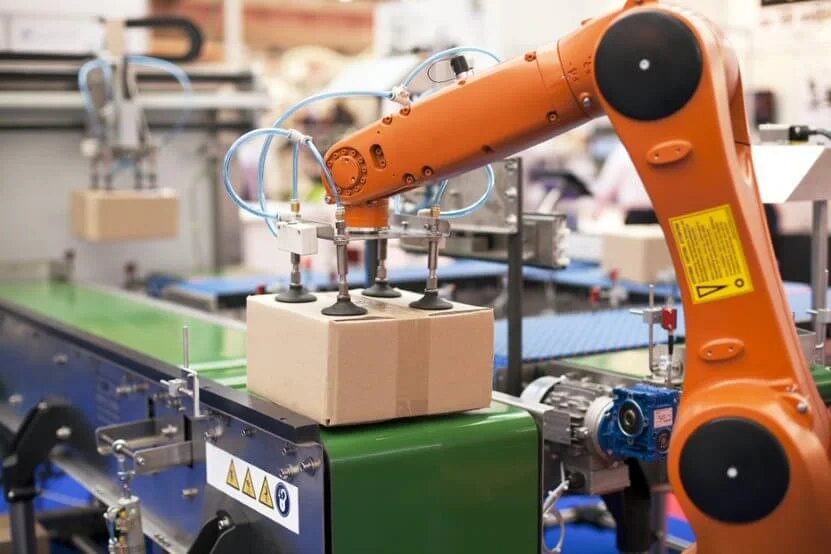
Robots in the factories
Industrial robots can be equipped with any type of tool; they are used with precision, accuracy, speed, and repetitiveness that can not be matched by humans. Industrial Robots have a multitude of sensors and vision systems capable of viewing images to aid with their computer-based control.
Industrial robots work in many industries, such as semiconductors and automobiles, plastics processing, and metal forging. They are worked in any repetitive operation, particularly if it’s dangerous or difficult for people. Industrial robots help manufacturers address many of the key challenges they face, including tight labor pools, global market competitiveness, and safety.
Good automation companies offer a support package of their expertise, which is an extremely important factor. Training can be given to engineers to allow them to program the robots, but the assistance of experienced automation companies is still required for the original integration of the robot.
Advantages of robots
The robots help increase the number of manufactured products and decrease the production of defective goods. They can produce the same quality products during the production process, they do not get exhausted, and they work for a long period of time.
Robots can be used in the computer industry; they are used in all kinds of electronics from radios to microwaves, they are used in packaging, and they are used in producing food, textiles, and drugs.
The robots help in doing dangerous jobs; they can work at a constant speed without sleep, breaks, vacations, or salaries, and they can produce more than human workers.
The robots can perform dangerous tasks in hazardous settings. They minimize material waste, they can save time & effort, and their movements are always exact.
Industrial robots help increase productivity in factories, they make businesses achieve more benefits, they can reduce the companies’ loss, they are used in dangerously polluted environments such as chemical spills and radioactive in nuclear power plants, and they are used in radioactive waste clean-up.
Robots have more precise guidance in doing the tasks, they are linked to powerful computers or controllers, and they contain machine vision sub-systems acting as their visual sensors, so, they are more flexible to the orientation of objects that they can perform the tasks on them.
We will see in the future machines that work alongside humans, and they will learn from them to perform an increasing number of manufacturing tasks.
Disadvantages of robots
Industries prefer utilizing robots to human workers, So, the unemployment rate will increase, and many people who can not get work will become poorer while the company owners will get richer.
Companies should calculate the cost of robotic automation in light business. It sometimes costs a lot of money greater than the financial budget, and they need regular maintenance, which costs a lot of money.
Robots can work in the factory with limitations. Humans do the tasks that require creativity, decision-making, adaptation, and job learning.
If the employees have no experience in dealing with the robots, they will need a training program to interact with the new robotic equipment, it will take time and cost a lot of money in the financial output.
Robots can protect human workers from some hazards. The robots can create other safety problems and they can cause new dangers that must be taken into consideration.
The companies must plan before using industrial robots, as using the robots without planning in the factories does not guarantee the results, so the companies will have difficulty achieving their goals.
Robots can produce lots of electronic waste. They can not do something that they were not designed to do, and they make people lazy.
FAQ About Robots in Factories
1. What are factory robots?
Factory robots are automated machines used in manufacturing to perform repetitive, dangerous, or precise tasks such as welding, assembling, painting, packaging, and material handling.
2. What types of robots are used in factories?
Common types include:
- Articulated robots – Used for welding and painting.
- SCARA robots – Ideal for assembly tasks.
- Cartesian robots – Used for pick-and-place operations.
- Collaborative robots (cobots) – Work safely alongside humans.
- Autonomous mobile robots (AMRs) – Move materials around factories.
3. What are the advantages of using robots in factories?
- Increased productivity.
- High precision and consistency.
- Reduced human error.
- Improved workplace safety.
- 24/7 operation capability.
- Lower long-term labor costs.
4. What are the disadvantages of factory robots?
- High initial installation cost.
- Maintenance and programming expenses.
- Potential job displacement.
- Dependence on technical expertise.
5. How do factory robots improve safety?
Robots handle hazardous tasks such as heavy lifting, working with toxic chemicals, or high-temperature welding, reducing workplace injuries.
6. Do robots replace human workers?
Not completely. Robots usually automate repetitive or dangerous tasks, while humans focus on supervision, maintenance, programming, and complex decision-making.
7. How are factory robots programmed?
They are programmed using:
- Teach pendants.
- Computer software.
- AI and machine learning systems.
- Pre-programmed motion paths.
8. What industries use factory robots?
- Automotive manufacturing.
- Electronics production.
- Food and beverage processing.
- Pharmaceutical industry.
- Packaging and logistics.
9. What is a collaborative robot (cobot)?
A cobot is a robot designed to work safely with humans without the need for protective cages. They are equipped with sensors to detect human presence and avoid collisions.
10. Are factory robots expensive?
The cost varies depending on size and function. While the upfront cost is high, robots often reduce operational expenses over time.
11. How do robots affect product quality?
Robots provide consistent accuracy and precision, reducing defects and improving overall product quality.
12. What is the future of robots in factories?
The future includes:
- Smarter AI-powered robots.
- Greater human-robot collaboration.
- Increased automation in small and medium factories.
- Integration with Industry 4.0 and IoT systems.
You can subscribe to Science Online on YouTube from this link: Science Online
Automation in manufacturing uses, advantages and disadvantages
Industrial robot (Auto industry) uses, advantages and disadvantages
Robot welding advantages over manual welding
Collaborative robot arm (cobot robots) applications, uses, advantages and disadvantages




Very informative
Thank you very much for your comment
Informative and detailed. Good effort. At some sites I would only find hardly two three but this is quite helpful.
Thank you very much for your comment
does this talk about the industrial robot arm
Yes , It talks about using of robots and industrial robot arm in the factory
Thanks for give important knowledge
You are welcome