
10 Powerful Reasons Why Heat Is Essential for Life and Daily Living
Heat is one of the most essential forms of energy in our universe. From keeping our bodies warm to powering industries and enabling life on Earth, heat plays a critical role in almost everything we do. Without heat, life as we know it would not exist. It affects natural processes, biological systems, and even modern technology in powerful ways.
Heat energy
Heat energy, often referred to as thermal energy, is the result of the movement of tiny particles—atoms, molecules, or ions—in solids, liquids, and gases. Essentially, it is the energy that is transferred from one body to another as a result of a difference in temperature.
Heat is a vital form of energy that supports life and drives many processes on Earth. It helps regulate body temperature, enables plants to produce food, and powers machines and industries. Heat is also essential in daily activities such as cooking and heating homes. Without heat, the Earth would be too cold to sustain life, making it one of the most important elements in our existence.
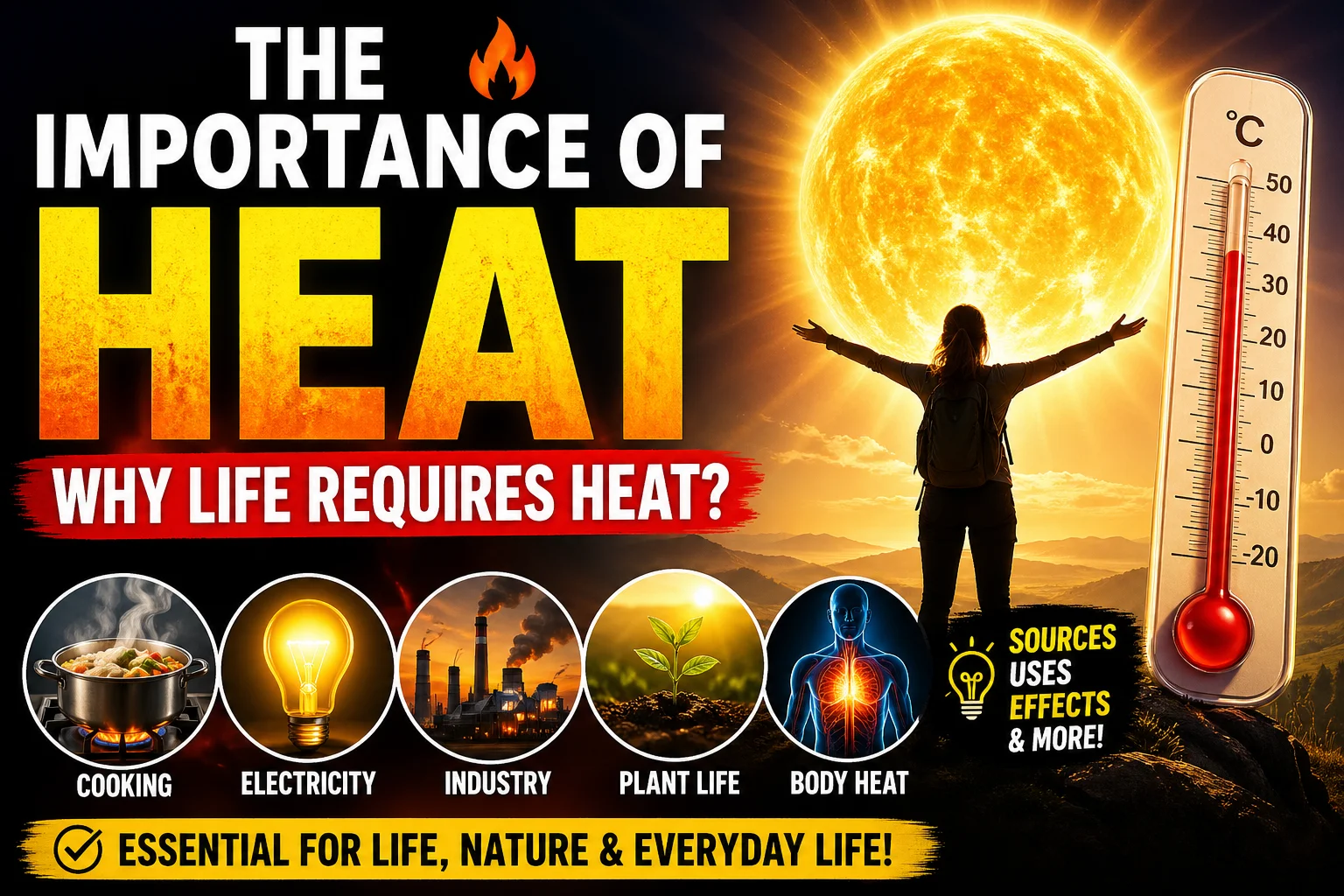
Importance of Heat in Our Daily Life
Core Concepts
- Particle Motion: Everything is made of atoms. These atoms are always moving. When you add heat to a substance, its atoms move faster, increasing its thermal energy.
- Direction of Flow: Heat naturally moves from an object with a higher temperature to an object with a lower temperature. It continues to move until both objects reach the same temperature (thermal equilibrium).
- Temperature vs. Heat: While often used interchangeably, they are different. Temperature is a measure of the average kinetic energy of the particles, whereas heat energy is the total energy of all molecular motion in that substance.
How Heat Moves
Heat energy is transferred in three primary ways:
- Conduction: The transfer of heat through direct contact (e.g., a metal spoon getting hot in a cup of coffee).
- Convection: The transfer of heat through the movement of fluids or gases (e.g., warm air rising toward the ceiling).
- Radiation: The transfer of heat through electromagnetic waves (e.g., feeling the warmth of the Sun or a campfire from a distance).
Units of Measurement
In the scientific community, heat energy is typically measured in Joules (J), which is the standard unit for all forms of energy. You may also see it measured in Calories (cal), which is defined as the amount of heat energy required to raise the temperature of one gram of water by 1°C.
Why Does Life Require Heat?
Life requires heat because it supports the chemical reactions necessary for survival. In living organisms, heat helps regulate body temperature, maintain metabolism, and ensure that vital processes such as digestion and respiration occur efficiently. Without heat, enzymes would not function properly, and cells would fail to operate.
Additionally, heat from the sun provides the energy needed for plants to perform photosynthesis, which produces oxygen and food for other living organisms. This makes heat a fundamental requirement for sustaining life on Earth.
Importance of Heat in Our Daily Life
Heat is deeply integrated into everyday life in ways we often take for granted. It helps us cook food, boil water, and stay warm during cold weather. Heat is also essential in generating electricity, running engines, and manufacturing goods.
In homes, heat is used for heating systems, cooking appliances, and water heaters. In industries, it is vital for processes such as metal production, chemical reactions, and food processing. Even in healthcare, heat is used for sterilization and therapeutic treatments.
10 Importance of Heat
- Heat maintains body temperature in humans and animals.
- It supports metabolic and biological processes.
- It enables cooking and food preparation.
- It helps in generating electricity.
- It powers engines and machines.
- It is essential for industrial manufacturing.
- It drives weather patterns and climate.
- It supports plant growth through photosynthesis.
- It is used in medical treatments and sterilization.
- It provides warmth and comfort in daily life.
Sources of Heat
Heat comes from various natural and artificial sources, including:
- The sun (primary source of heat on Earth).
- Fire and combustion.
- Electricity.
- Chemical reactions.
- Geothermal energy (heat from inside the Earth).
- Friction (rubbing objects together).
Uses of Heat
Heat has countless practical uses, such as:
- Cooking food and boiling water.
- Heating homes and buildings.
- Generating electricity in power plants.
- Operating engines and vehicles.
- Manufacturing materials like steel and glass.
- Drying clothes and preserving food.
What Is the Effect of Heat?
Heat has several important effects on matter and living systems. It can raise the temperature, cause expansion, and change the state of substances (solid to liquid, liquid to gas). In living organisms, heat helps maintain proper body function, but excessive heat can lead to dehydration or heat-related illnesses. Heat also influences the environment by driving weather patterns, ocean currents, and seasonal changes.
FAQ About the Importance of Heat
1. Why is heat important for humans?
Heat is essential for maintaining body temperature and supporting vital processes like metabolism and digestion.
2. What would happen without heat?
Without heat, Earth would become extremely cold, and life would not survive due to the lack of energy for biological processes.
3. What is the main source of heat on Earth?
The sun is the primary source of heat and energy for life on Earth.
4. How is heat used in daily life?
Heat is used in cooking, heating homes, generating electricity, and industrial processes.
5. Can heat be harmful?
Yes, excessive heat can cause burns, dehydration, and heatstroke, making it important to manage exposure.
Conclusion
Heat is a fundamental force that sustains life and powers the world around us. From supporting biological functions to enabling technological advancements, its importance cannot be overstated. Understanding heat and its role helps us appreciate how essential it is to our survival and everyday comfort.
You can follow science online on YouTube from this link: Science online
Importance of heat (thermal energy) and light energy in our daily life
Importance of heating in Agriculture, Horticulture and the greenhouse
Importance of good and bad conductors of heat – FAQs & Examples
Solar energy (Sun), Ways of heat transfer (conduction, convection, and radiation)
Metallic and nonmetallic properties, Acidic and basic properties in the periodic table
Heat changes accompanying physical changes, and Explanation of the source of the heat of solution
Heat Changes accompanying Chemical changes and Hess’s law of constant heat summation