7 Amazing Properties of Molecules of Matter: Structure, Characteristics, and Real-Life Examples
Properties of molecules of matter help explain why solids, liquids, and gases behave differently in everyday life. By understanding how molecules move, attract each other, and occupy space, students can easily grasp the basic concepts of matter and its physical properties through simple, real-world examples.
Properties of Molecules of Matter
The molecule
The matter is composed of small building units called molecules, which are composed of tiny structural units called atoms, and it is anything that has mass and occupies space. The molecule is the smallest part of matter that can exist freely, and it has the properties of matter.
What are the properties of the molecules of matter?
Intermolecular forces
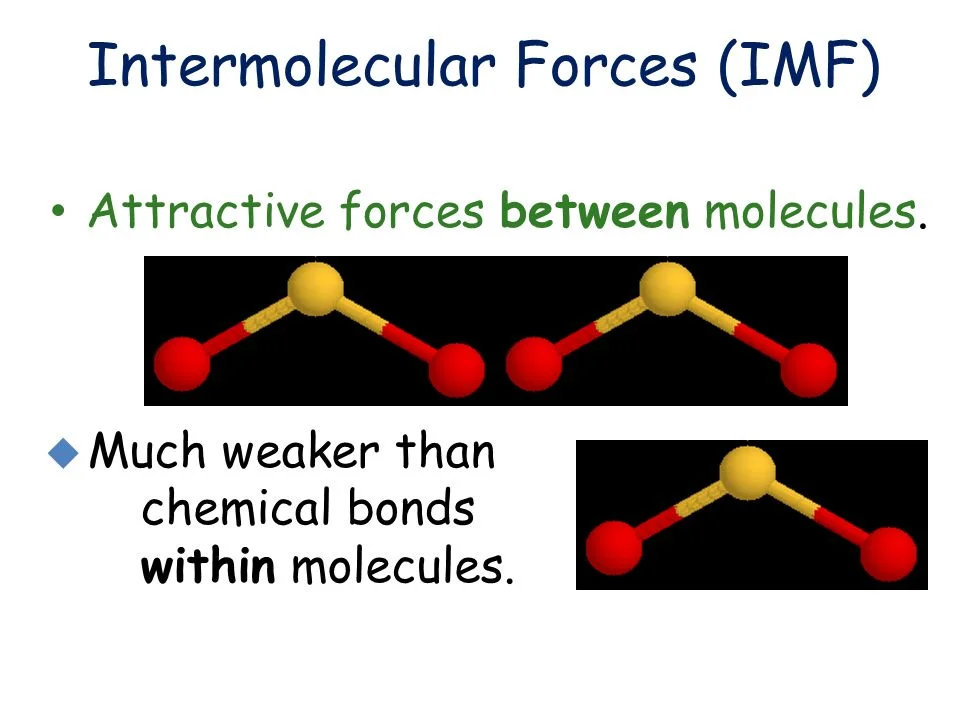
The intermolecular forces are forces that keep the molecule together, such as the bonds, while the intermolecular forces are the attractive force between the molecules, which is responsible for keeping the matter in the solid or liquid phase. The molecules of matter are in a continuous motion, there are intermolecular spaces among the molecules of matter, and there are attractive forces among the molecules of matter.
When you leave the perfume bottle open, you smell it all over the room as the molecules of the perfume are in continuous motion, and they keep the properties of the perfume. The molecules of solid matter have an oscillatory motion, while the motion of liquids is limited, and the motion of gases is limited.
The drop of ink spreads through the water as the molecules of ink are in a state of continuous motion in all directions among the water molecules. There are intermolecular spaces among the molecules of matter, which are the spaces that are found among the molecules of matter.
The volume of a mixture of water and alcohol is less than the sum of their volumes before mixing, as some molecules of alcohol occupy the intermolecular spaces among the water molecules.
There are intermolecular forces among the molecules of matter; the intermolecular force is the force that binds the molecules of matter together. It is difficult to break an iron piece with your fingers because there is a strong attractive force between iron molecules.
Properties of Molecules of Matter
Properties of molecules of matter explain why different substances exist as solids, liquids, or gases and how they behave under various conditions. Every object around us—from air and water to rocks and metals—is made of tiny particles called molecules. These molecules have unique properties that determine the physical characteristics of matter. Understanding these properties is essential for students, scientists, and anyone interested in learning the fundamentals of chemistry and physics.
What are Molecules of Matter?
Molecules are the smallest particles of a substance that can exist independently while retaining the chemical properties of that substance. They are composed of two or more atoms chemically bonded together. Although molecules are incredibly small and cannot be seen with the naked eye, they make up everything around us.
For example:
- A water molecule consists of two hydrogen atoms and one oxygen atom (H₂O).
- An oxygen molecule contains two oxygen atoms (O₂).
- A carbon dioxide molecule consists of one carbon atom and two oxygen atoms (CO₂).
1. Molecules Are Extremely Small
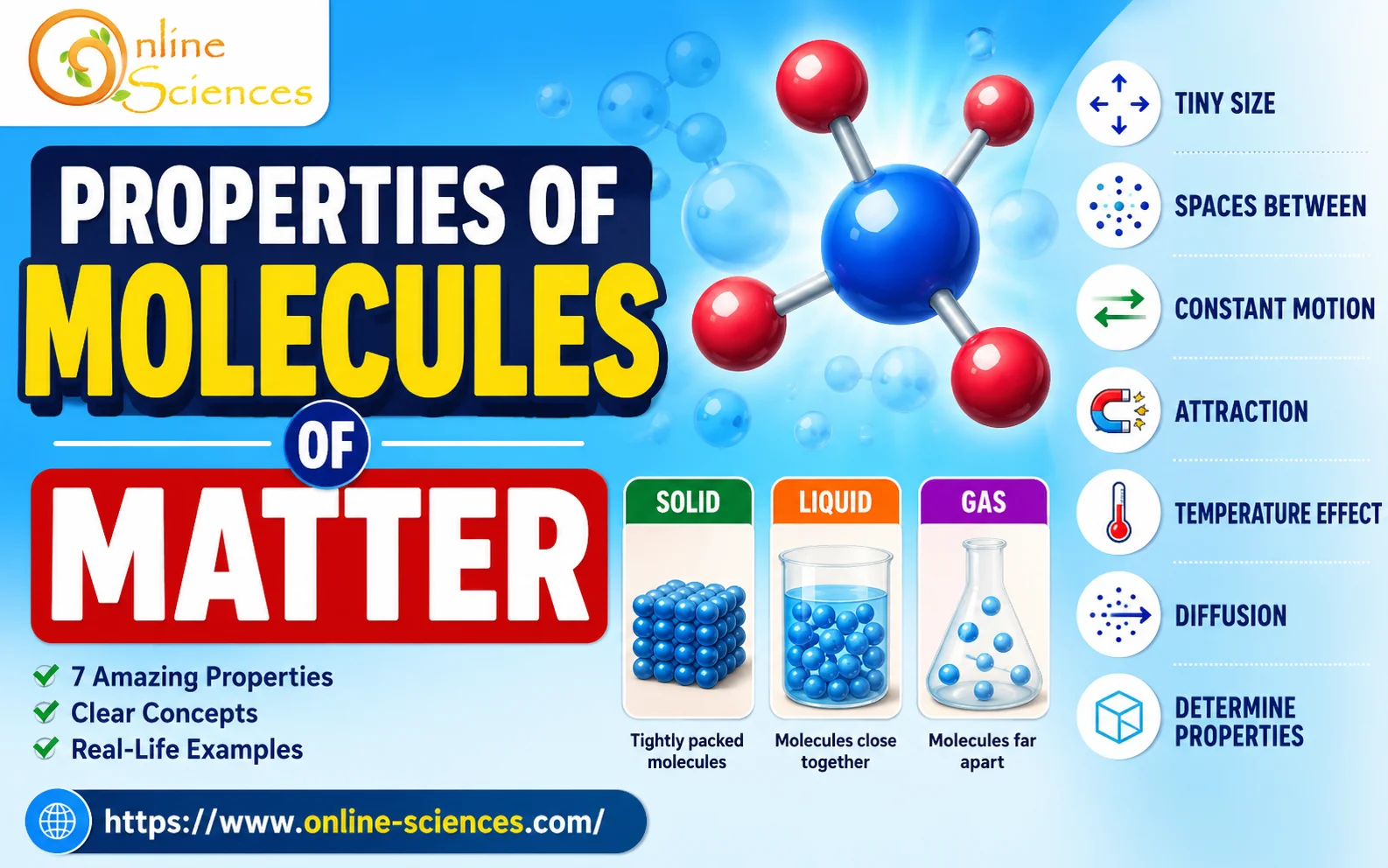
One of the most important properties of molecules is their tiny size. Millions of molecules can fit into a single drop of water. Their microscopic size makes them invisible without powerful scientific instruments. Because molecules are so small, substances appear smooth and continuous to our eyes even though they are made of countless individual particles.
2. Molecules Have Spaces Between Them
There are empty spaces between molecules, known as intermolecular spaces. The amount of space depends on the state of matter. Solids have very little space between molecules. Liquids have moderate spaces. Gases have large spaces between molecules. These spaces explain why gases are easily compressed while solids are not.
3. Molecules Are Always Moving
Molecules are never completely at rest. They constantly move in different ways depending on the state of matter. In solids, molecules vibrate around fixed positions. In liquids, molecules slide past one another. In gases, molecules move freely and rapidly in all directions. As the temperature increases, molecular movement becomes faster because molecules gain more kinetic energy.
4. Molecules Attract One Another
Molecules exert attractive forces on each other called intermolecular forces. These forces hold substances together. The strength of these attractive forces varies:
- Strong in solids.
- Moderate in liquids.
- Weak in gases.
This difference explains why solids keep their shape while gases spread to fill any available space.
5. Molecular Motion Depends on Temperature
Temperature directly affects how molecules move.
When a substance is heated:
When cooled:
- Molecules lose energy.
- Their movement slows.
- They move closer together.
This principle explains expansion during heating and contraction during cooling.
6. Molecules Can Diffuse
Diffusion is the movement of molecules from an area of high concentration to an area of low concentration.
Examples include:
- Perfume spreads throughout a room.
- Food coloring mixing with water.
- The smell of cooking reaches another room.
Diffusion occurs fastest in gases because their molecules move freely.
7. Molecules Determine the Physical Properties of Matter
The arrangement and movement of molecules determine many physical properties, including:
- Density.
- Hardness.
- Shape.
- Volume.
- Elasticity.
- Boiling point.
- Melting point.
- Viscosity.
Different molecular structures give materials their unique characteristics.
Properties of Molecules in Different States of Matter
Solids
In solids, molecules are tightly packed with very strong attractive forces. They vibrate in fixed positions, giving solids a definite shape and volume.
Examples:
- Iron.
- Wood.
- Glass.
- Ice.
Liquids
In liquids, molecules remain close together but can move around one another. Liquids have a definite volume but no fixed shape, allowing them to flow and take the shape of their container.
Examples:
- Water.
- Milk.
- Oil.
- Juice.
Gases
Gas molecules are far apart and move rapidly in all directions. They have neither a fixed shape nor a fixed volume and can be compressed easily.
Examples:
- Oxygen.
- Nitrogen.
- Carbon dioxide.
- Water vapor.
Importance of Studying the Properties of Molecules of Matter
Understanding molecular properties helps us explain countless natural and industrial processes. Scientists use molecular behavior to develop medicines, improve materials, design engines, produce cleaner energy, and create new technologies. Students also use these concepts to understand chemical reactions, changes of state, diffusion, pressure, and temperature effects.
Everyday Examples of Molecular Properties
Many everyday experiences are explained by molecular behavior:
- Ice melts because molecules gain energy and move more freely.
- Steam forms when water molecules move rapidly enough to become a gas.
- Balloons expand in warm weather as gas molecules move faster.
- Sugar dissolves in tea because molecules diffuse throughout the liquid.
- Metal rails expand on hot days due to increased molecular motion.
Summary
The properties of molecules of matter are fundamental to understanding the behavior of all substances. Molecules are incredibly small, constantly moving, separated by tiny spaces, and attracted to one another by intermolecular forces. Their motion changes with temperature; they diffuse naturally, and together they determine the physical properties of solids, liquids, and gases. Learning these principles provides the foundation for chemistry, physics, biology, and many real-world applications.
Frequently Asked Questions (FAQs) about molecules
1. What are the main properties of molecules of matter?
The main properties are that molecules are extremely small, have spaces between them, are constantly moving, attract one another, move faster when heated, diffuse naturally, and determine the physical properties of substances.
2. Why are molecules always moving?
Molecules possess kinetic energy, which causes continuous motion. Higher temperatures increase their kinetic energy and make them move faster.
3. What happens to molecules when matter is heated?
Heating gives molecules more energy, causing them to move faster and spread farther apart, often leading to expansion or a change of state.
4. Why do gases spread throughout a room?
Gas molecules move freely and rapidly in all directions, allowing them to diffuse and fill any available space.
5. How do molecules affect the properties of matter?
The arrangement, spacing, movement, and attractive forces between molecules determine properties such as density, hardness, melting point, boiling point, shape, and volume.
6. What is diffusion?
Diffusion is the natural movement of molecules from a region of higher concentration to a region of lower concentration until they become evenly distributed.
You can subscribe to science online on YouTube from this link: Science Online