Classification of Metals According to Their Chemical Activity: 3 Powerful Facts with Examples
Classification of metals according to their chemical activity helps us understand why some metals react rapidly with water, oxygen, and acids, while others remain almost unchanged for years. The chemical activity of metals plays an important role in chemistry, engineering, manufacturing, corrosion prevention, and selecting the right materials for different applications.
Classification of Metals According to Their Chemical Activity
Metals
Metals can be classified according to their chemical activity into three groups which are very active metals, less active metals, and inactive metals. The high reactivity of active metals makes them useful in a variety of applications. Sodium is used in the production of chlorine and soap. Potassium is an essential nutrient for plants and animals.
Very active metals
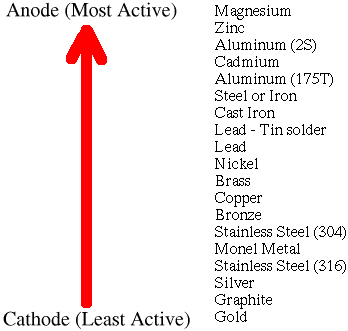
Activity series of metals
Very active metals are metals that react with oxygen as soon as being exposed to humid air, so they lose their metallic luster such as sodium and potassium, Sodium and potassium are kept under the kerosene surface to prevent their reaction with the atmospheric oxygen.
Less active metals
Less active metals are the metals that react with oxygen if they are left in the air for some days and a layer of rust is formed such as iron, aluminum, and copper.
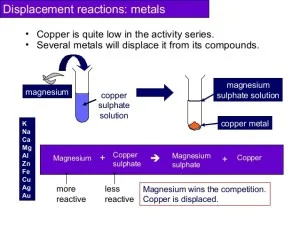
Copper is low in the activity series.
Steel bridges and the holders of light bulbs are painted from time to time to protect them from rust and corrosion. Metallic spare parts of cars are covered with grease to protect them from rust and corrosion. Washing of cooking pans that are made of aluminum with a rough material to remove any layer formed on them.
Inactive metals
Gold and silver are very inactive
Inactive metals are metals that find great difficulty in reacting with oxygen, such as silver, platinum, nickel, gold, and chromium. Silver and gold are used in making jewels because silver and gold are chemically poorly active. Nickel, gold, and silver are used to cover other substances that rapidly rust to protect them from corrosion.
What is the classification of metals based on the reactivity series?
Metals can be classified into several categories based on their chemical activity, with the most common system using four main groups:
1. Most Active Metals
These are the most reactive metals and readily lose electrons to form cations. They are found in Groups IA (alkali metals) and IIA (some alkaline earth metals) of the periodic table. Examples include lithium (Li), sodium (Na), potassium (K), magnesium (Mg), and calcium (Ca). These metals react vigorously with water at room temperature, releasing hydrogen gas and forming a metal hydroxide solution. Due to their high reactivity, they are not found in their elemental state in nature but are bonded with other elements in minerals.
2. Moderately Active Metals
These metals are less reactive than the most active group. They don’t react with water at room temperature but can react readily with acids. They are located further to the right in Groups IA and IIA and some transition metals. Examples include zinc (Zn), iron (Fe), and lead (Pb). These metals require stronger acids or specific conditions to react and form salts.
3. Less Active Metals
This group includes metals with lower reactivity. They only react with strong acids or require high temperatures. They are found scattered across the periodic table, including some transition metals and metalloids. Examples include chromium (Cr), nickel (Ni), and tin (Sn). These metals require concentrated acids or specific oxidizing agents to participate in reactions.
4. Noble Metals
These are the least reactive metals. They are referred to as noble metals because they resist corrosion and oxidation due to their strong electron configuration. They are located on the far right of the periodic table, including platinum (Pt), gold (Au), and silver (Ag). Noble metals do not react with water or most acids at room temperature.
Active metals
Active metals are those that readily react with other substances due to their electronic configuration. They tend to lose electrons easily to form positively charged ions (cations). These metals are found on the leftmost side of the periodic table, in Groups IA and IIA.
The most active metals are the alkali metals in Group IA: lithium (Li), sodium (Na), potassium (K), rubidium (Rb), cesium (Cs), and francium (Fr). These elements all have just one valence electron in their outermost shell, which they are very willing to give up. This makes them highly reactive, especially with non-metals such as halogens (like chlorine) and oxygen. Lithium is used in batteries and medications.
Alkali metals react vigorously with water to produce hydrogen gas and a metal hydroxide. The reactivity increases as you go down the group because the atoms get larger and it becomes easier to remove the outer electron. The alkali metals are so reactive that they are not found in nature in their elemental state, but rather combined with other elements in minerals. Francium is so reactive that it is radioactive and only exists in minute quantities in nature.
Some of the alkaline earth metals in Group IIA, such as calcium (Ca), strontium (Sr), and barium (Ba), are also considered active metals. They have two valence electrons, but they are also relatively loosely held and can be readily lost to form a +2 cation, although they are not quite as reactive as the alkali metals.
The reactivity of active metals increases as you go down their group in the periodic table. This is because the outer electrons are farther from the nucleus and therefore less attracted to it, making them easier to remove.
Properties of active metals
- Low ionization energy: They require very little energy to remove an electron from their outermost shell.
- High reactivity: They readily react with non-metals, such as halogens (e.g., chlorine, fluorine) and oxygen, to form ionic compounds. For example, sodium reacts vigorously with water to form hydrogen gas and sodium hydroxide.
- Softness: They are generally soft and can be easily cut with a knife. They are easily bent and shaped because the metallic bonds between the atoms are weak.
- Low melting and boiling points: They tend to have low melting and boiling points because the metallic bonds between the atoms are weak. The weak metallic bonds also make them easy to melt and vaporize.
- Good conductors of heat and electricity: They are good conductors because they have freely moving valence electrons.
- Due to their high reactivity, active metals are not typically found in nature in their pure form. They are usually found in compounds, such as oxides, sulfides, or carbonates.
Classification of Metals According to Their Chemical Activity
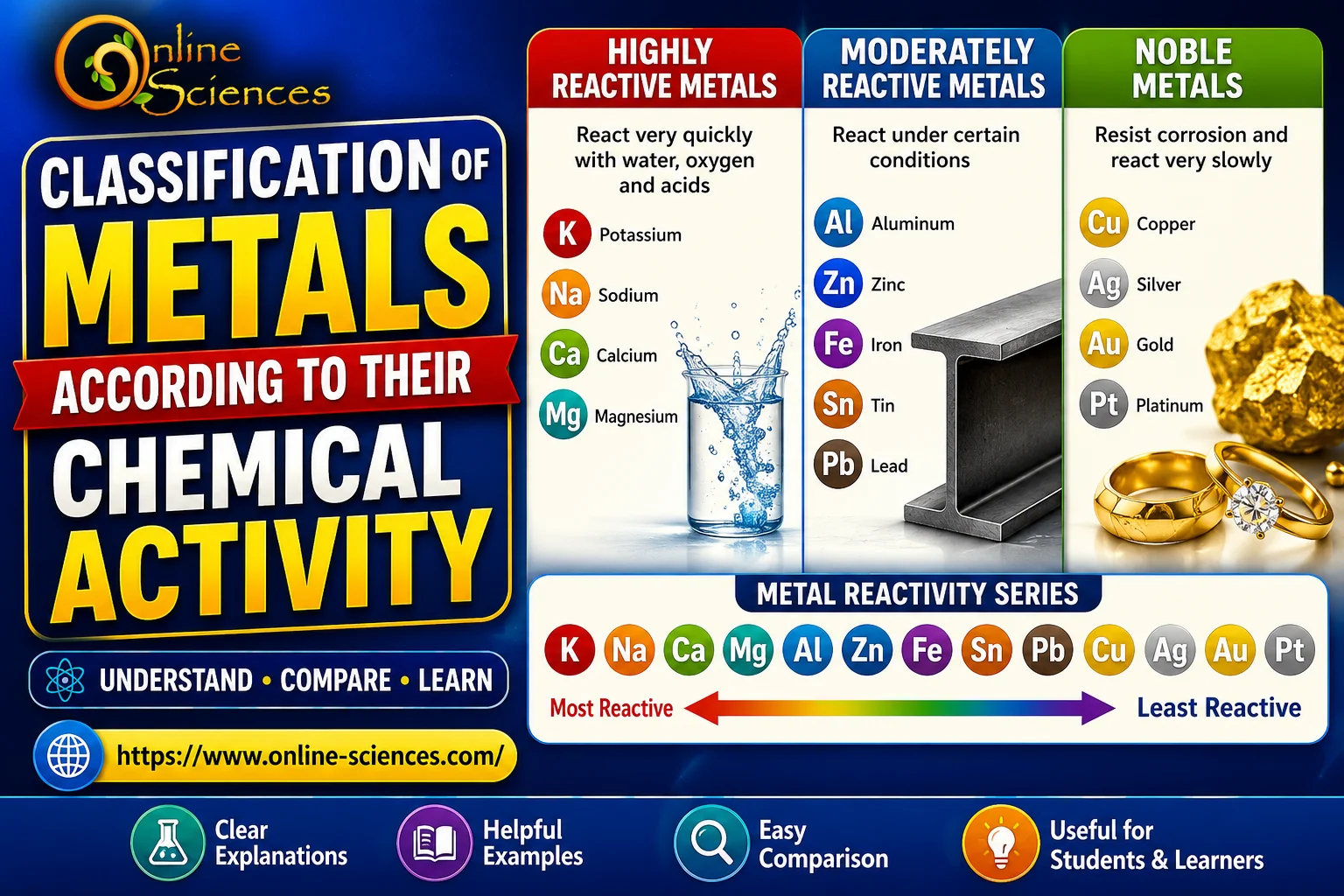
Metals differ greatly in their ability to react with other substances. This difference is known as their chemical activity or reactivity. Based on their reactivity, metals are classified into three main groups.
1. Highly Reactive Metals
These metals lose electrons very easily and react quickly with oxygen, water, and acids.
Examples
- Potassium (K).
- Sodium (Na).
- Calcium (Ca).
- Magnesium (Mg).
Characteristics
- React vigorously with water.
- Form alkaline hydroxides and release hydrogen gas.
- Oxidize rapidly in air.
- Cannot be found in nature as pure metals.
- Stored under oil to prevent reaction with moisture and oxygen.
Example Reaction
Sodium + Water
2Na + 2H₂O → 2NaOH + H₂
2. Moderately Reactive Metals
These metals react under certain conditions but are less reactive than alkali and alkaline earth metals.
Examples
- Aluminum (Al).
- Zinc (Zn).
- Iron (Fe).
- Tin (Sn).
- Lead (Pb).
Characteristics
- React with dilute acids.
- React slowly with water or only with steam.
- Form protective oxide layers in some cases.
- Widely used in construction and manufacturing.
Example Reaction
Zn + 2HCl → ZnCl₂ + H₂
3. Least Reactive Metals (Noble Metals)
These metals are highly resistant to corrosion and oxidation.
Examples
- Copper (Cu).
- Silver (Ag).
- Gold (Au).
- Platinum (Pt).
Characteristics
- Do not react with water.
- Resist oxidation.
- Rarely react with dilute acids.
- Maintain their shine for many years.
- Used in jewelry, electronics, and medical equipment.
Metal Reactivity Series
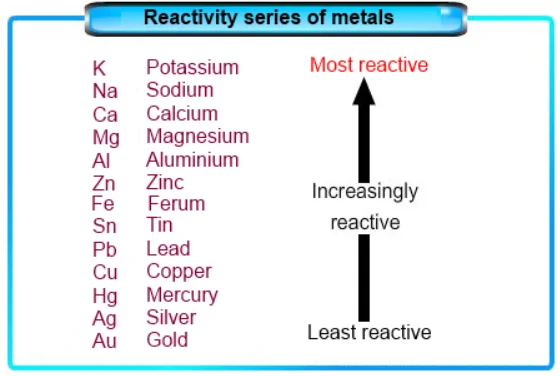
The Metal Reactivity Series is a ranking of metals from the most chemically reactive to the least reactive based on how easily they lose electrons and form positive ions. The series generally follows the order: Potassium (K) > Sodium (Na) > Calcium (Ca) > Magnesium (Mg) > Aluminum (Al) > Zinc (Zn) > Iron (Fe) > Tin (Sn) > Lead (Pb) > Copper (Cu) > Silver (Ag) > Gold (Au) > Platinum (Pt).
Metals at the top of the series react vigorously with water and acids and are strong reducing agents, while those at the bottom are much less reactive and are highly resistant to corrosion. The reactivity series is widely used to predict displacement reactions, determine methods for extracting metals from ores, and select suitable metals for industrial, engineering, and everyday applications.
What is the Chemical Activity of Metals?
The chemical activity of metals is the tendency of a metal to lose electrons and react with substances such as oxygen, water, acids, and other chemicals. Metals with high chemical activity lose electrons easily and form positive ions, while less reactive metals hold their electrons more strongly and resist chemical reactions. The chemical activity of a metal depends on several factors, including:
- Atomic structure.
- Number of valence electrons.
- Ionization energy.
- Position in the periodic table.
- Ability to lose electrons.
Factors Affecting the Chemical Activity of Metals
- Atomic Size: Larger atoms usually lose electrons more easily, making them more reactive.
- Ionization Energy: Metals with low ionization energy lose electrons readily and react faster.
- Number of Valence Electrons: Metals with one or two valence electrons generally have higher chemical activity.
- Environmental Conditions: Temperature, humidity, oxygen concentration, and acid strength influence the rate of reaction.
Reactions That Demonstrate Chemical Activity
Reaction with Oxygen
Reactive metals form metal oxides rapidly.
Example: 4Fe + 3O₂ → 2Fe₂O₃
Reaction with Water
Highly reactive metals react vigorously with cold water.
Example: 2K + 2H₂O → 2KOH + H₂
Reaction with Acids
Many metals release hydrogen gas when reacting with dilute acids.
Example: Mg + 2HCl → MgCl₂ + H₂
Importance of Classifying Metals by Chemical Activity
Understanding metal reactivity helps scientists and engineers:
- Select suitable construction materials.
- Prevent corrosion and rust.
- Manufacture batteries.
- Extract metals from ores.
- Design chemical processes.
- Produce durable industrial equipment.
- Improve recycling methods.
Applications in Everyday Life
Different metals are chosen for specific purposes based on their chemical activity.
- Aluminum: Aircraft, beverage cans, and kitchen utensils.
- Iron: Buildings, bridges, machinery, and vehicles.
- Copper: Electrical wiring and electronics.
- Gold: Jewelry, electronics, and dentistry.
- Magnesium: Lightweight automotive and aerospace components.
Difference Between Highly Reactive and Noble Metals
Highly reactive metals, such as potassium, sodium, and calcium, lose electrons easily and react rapidly with water, oxygen, and acids. Because of their high chemical activity, they corrode quickly and are usually found in nature as compounds rather than in their pure form.
In contrast, noble metals like gold, silver, and platinum have very low chemical activity. They resist oxidation and corrosion, react very slowly or not at all with water and dilute acids, and can often be found in their native (pure) state. This exceptional resistance makes noble metals ideal for jewelry, electronics, medical devices, and applications requiring long-lasting durability.
Frequently Asked Questions (FAQ)
1. What is meant by the chemical activity of metals?
Chemical activity is the tendency of a metal to lose electrons and react with substances such as oxygen, water, and acids.
2. Which metals are the most chemically active?
Potassium, sodium, calcium, and magnesium are among the most chemically active metals.
3. Which metals are the least reactive?
Gold, platinum, silver, and copper are the least reactive metals.
4. Why are highly reactive metals stored under oil?
They react rapidly with oxygen and moisture in the air, so oil prevents these reactions.
5. What is the metal activity series?
It is a ranking of metals from the most reactive to the least reactive based on their tendency to lose electrons.
6. Why is iron more reactive than copper?
Iron loses electrons more easily than copper, making it react faster with oxygen and acids.
7. Why is gold resistant to corrosion?
Gold has very low chemical activity and does not easily react with oxygen, water, or most acids.
8. How is the reactivity series useful?
It helps predict chemical reactions, choose suitable construction materials, extract metals from ores, and prevent corrosion.
9. Does aluminum react easily?
Aluminum is moderately reactive, but a thin oxide layer forms on its surface, protecting it from further corrosion.
10. Why is understanding metal reactivity important?
It is essential for chemistry, engineering, metallurgy, manufacturing, corrosion control, and environmental protection.
You can subscribe to science online on YouTube from this link: Science Online
Modern periodic table and classification of Elements
Radius property, Ionization potential, Electron affinity and Electronegativity
Metallic and nonmetallic properties, Acidic and basic properties in the periodic table
Chemical combination, Properties of Metals, Nonmetals and Noble (inert) gases