
Shocking Energy Transformation Inside Cars in 2026: What is the process of energy transformation?
Energy transformation inside cars is one of the most important scientific concepts in modern automotive engineering. In 2026, vehicles will use advanced systems to convert chemical, electrical, and thermal energy into motion with greater efficiency and lower emissions than ever before.
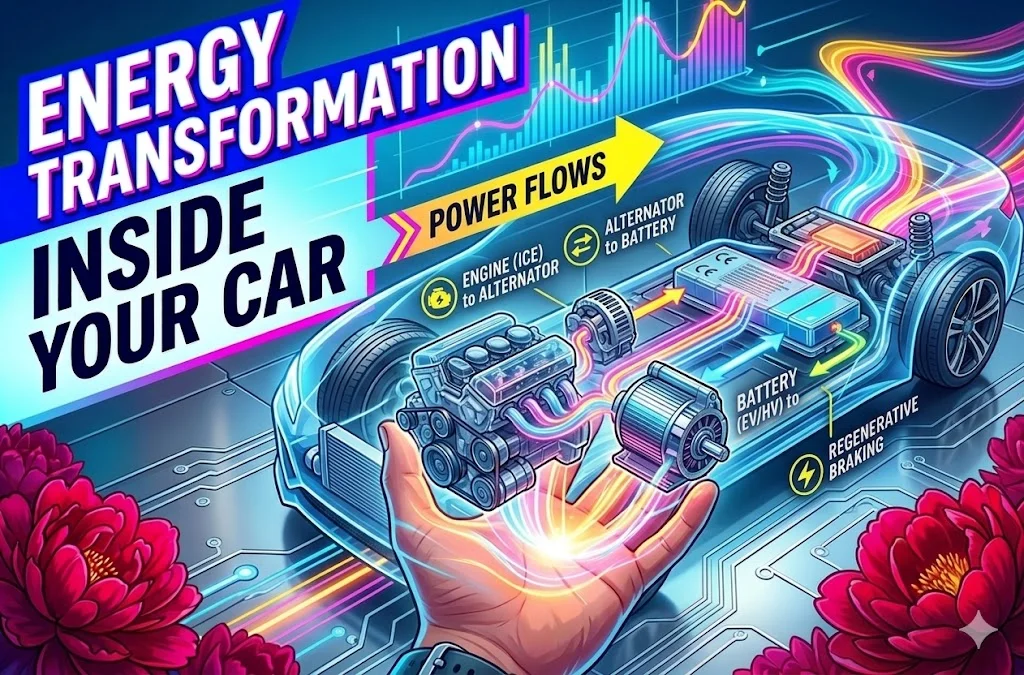
Energy transformation inside cars
Energy transformation
Energy conversion or Energy transformation is the process of changing one form of energy to another. The energy produces certain changes within a system. Changes in the total energy of systems can only be accomplished by adding or removing energy from them, as energy is a quantity that is conserved (unchanging).
Energy conversion in cars
Energy in many of its forms may be used in natural processes. It provides some services to society, such as heating, refrigeration, and light, and it performs mechanical work to operate the machines.
The internal combustion engine in the car converts the potential chemical energy in gasoline and oxygen into thermal energy, which is transformed into the mechanical energy that accelerates the vehicle (increasing its kinetic energy) by causing the pressure and performing the work on the pistons.
There is a useful energy transfer in the car engine. You can see that the car engine transfers the chemical energy that is stored in the fuel into the kinetic energy of expanding gas via combustion in the engine and the wheels.
Energy transformation inside cars
The heat energy changes into mechanical energy, which moves the car, and the chemical energy stored in the fuel changes into thermal (heat) energy in the car engine.
The kinetic energy of the expanding gas is converted to linear piston motion, which is converted to rotary crankshaft motion. The rotary crankshaft motion is transmitted to the transmission assembly.
The rotary movement is passed through the differential, then the rotary movement is passed out of the differential to the drive wheels, and then the rotary movement of the drive wheels is converted to the linear motion of the vehicle.
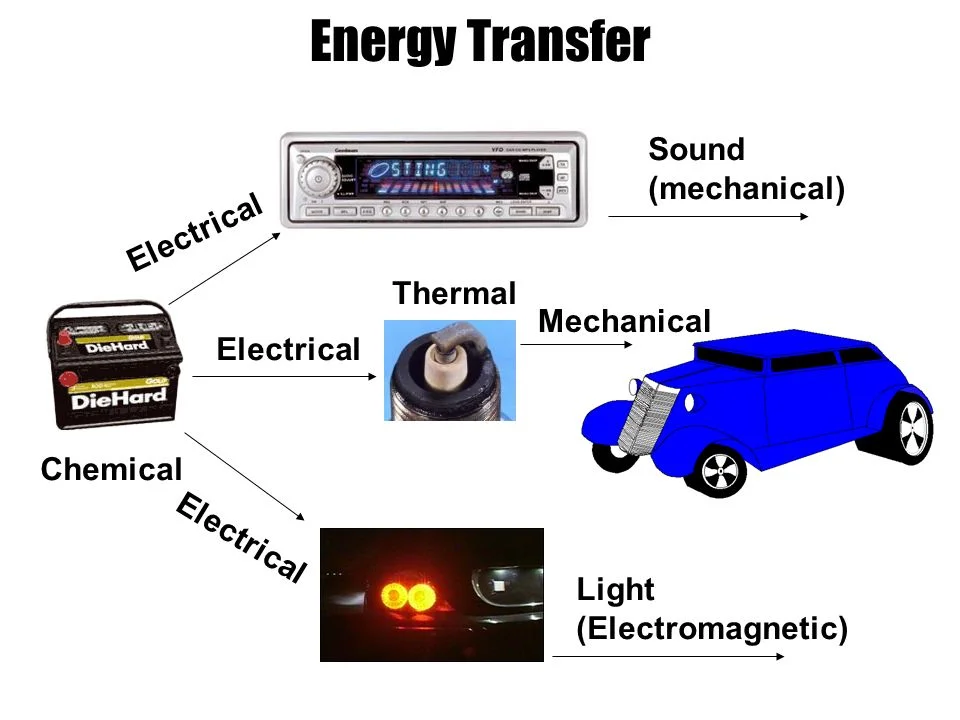
The cars are useful in our lives, and you know that the mechanical energy (the kinetic energy) changes into the electric energy in the car dynamo, and a part of the electric energy changes into the light energy in the car lamps.
A part of the electric energy changes into the sound energy in the car radio cassette, and a part of the electric energy changes into the heat energy in the electric heater of the car air conditioner.
When the battery is used to start the car, the energy is converted from electrical to mechanical energy to move the car. The chemical energy in the form of gasoline is converted to mechanical energy, and each transformation leads to the production of heat.
You can feel that the tires are warm from the friction after a long trip, the hood of the car is warm from the radiant heat of the engine, and there is a transformation of chemical energy to electrical energy to mechanical energy to start the car.
The car has much energy that is stored in its battery. When the car moves, it converts some of this stored electrical energy into kinetic energy. It is completely internal in the car, and no energy is transferred across the car or the road boundary.
You can’t store the momentum in a battery. Any onboard momentum would necessarily show up as the motion of the system’s center of mass, so any change in the momentum of a system simply must be due to a transfer across the boundary of the system.
The frictional interaction between the tires and the road imparts forward momentum to the car tires and, of course, a corresponding backward momentum to the road.
Importance of Energy transformation inside the cars
Energy transformation is crucial for cars to function. It’s what allows the car to take stored energy, in the form of fuel or electricity, and convert it into the kind of energy needed to move the car: kinetic energy.
Making the Engine Run: In traditional gasoline-powered cars, the key transformation happens in the engine. Chemical energy stored in the fuel (gasoline) is transformed into thermal energy through combustion. This heat energy then pushes pistons inside the engine and gets converted into mechanical energy that drives the pistons and crankshaft, ultimately propelling the car forward.
Powering the Movement: The mechanical energy created by the engine is then transferred through the drivetrain. This network of components, including the transmission, axles, and wheels, takes the rotational energy from the engine and translates it into the car’s motion.
Efficiency and Performance: Transformations happen throughout a car. Car engineers strive to optimize these transformations to reduce wasted energy as heat and improve the car’s efficiency and performance. Not all the energy from fuel gets converted into motion. Some thermal energy is lost as heat, and some mechanical energy is lost due to friction in the drivetrain.
Electric Vehicles: Electric vehicles (EVs) have a different kind of energy transformation. They use electrical energy stored in batteries to power electric motors. This transformation from electrical to mechanical energy directly powers the wheels.
Electric vehicles (EVs) are different: Electric vehicles don’t have combustion engines. Instead, they use electric motors powered by batteries. The transformation is from chemical energy stored in the battery to electrical energy that runs the motor, and then to mechanical energy for the wheels.
Regenerative braking: A cool feature in some EVs is regenerative braking. This captures the kinetic energy of the car when it slows down and converts it back into electrical energy, which can be stored in the battery and used later. This improves efficiency and extends the car’s driving range.
Efficient energy transformation is key to a car’s functionality, range, and environmental impact.
- Performance: Getting the most power and speed possible from the available fuel source.
- Fuel Economy: Minimizing wasted energy translates to better gas mileage or longer range in electric vehicles.
- Reduced Emissions: Less wasted energy means less fuel is burned, which can lead to lower emissions and a cleaner environment.
The efficient energy transformation is what keeps cars moving, both in the traditional and electric sense. It allows them to use fuel or battery power effectively to overcome friction, air resistance, and gravity, ultimately propelling us down the road.
Energy in many types of Cars
Energy transformation inside cars involves the conversion of energy from one form to another to enable the movement and power of various systems. The process differs based on the type of car—internal combustion engine (ICE) vehicles, hybrid vehicles, or electric vehicles (EVs).
1. Internal Combustion Engine (ICE) Cars
- These cars use fossil fuels (like gasoline or diesel) as their primary energy source.
- Chemical Energy to Thermal Energy: Fuel is burned in the engine’s combustion chamber, releasing chemical energy stored in the fuel as heat.
- Thermal Energy to Mechanical Energy: The heat causes the gases to expand, moving pistons. The pistons’ movement is transferred to the crankshaft, converting thermal energy into mechanical energy.
- Mechanical Energy for Motion: The crankshaft transfers energy to the drivetrain, turning the wheels and moving the car.
- Electrical Energy: A portion of the engine’s mechanical energy powers an alternator, which generates electricity for lights, sensors, and onboard electronics.
- Sound and Heat Loss: Some energy is lost as sound and heat, which is why ICE engines are not 100% efficient.
2. Hybrid Cars
- Hybrids combine ICE technology with an electric motor and battery.
- ICE Transformations: Same as above.
- Electrical Energy for Motion: The battery stores electrical energy, which powers an electric motor to drive the car.
- Regenerative Braking: Mechanical energy during braking is converted back into electrical energy, recharging the battery.
3. Electric Vehicles (EVs)
- EVs rely solely on electrical energy stored in batteries.
- Electrical Energy to Mechanical Energy: Energy from the battery is sent to an electric motor. The motor converts electrical energy into mechanical energy to turn the wheels.
- Regenerative Braking: Similar to hybrids, EVs recover energy during braking, converting mechanical energy back to electrical energy.
Energy Losses
Across all car types, energy losses occur due to:
- Friction in mechanical components.
- Heat dissipation.
- Sound energy production.
- Air resistance and tire friction during movement.
Efficiency Comparison
- EVs are generally more efficient because they avoid the thermal energy step, directly converting stored electrical energy into motion.
- ICE vehicles lose significant energy as heat.
- Hybrids aim to balance the strengths of ICE and EV systems.
Energy Transformation Inside the Cars in 2026
Energy transformation inside cars in 2026 has become more advanced due to the rapid growth of electric and hybrid vehicle technology. In traditional gasoline cars, chemical energy stored in fuel is converted into thermal energy through combustion inside the engine. This thermal energy then changes into mechanical energy that moves the pistons and powers the wheels. Modern cars also use smart energy recovery systems that transform braking energy into electrical energy, improving fuel efficiency and reducing energy waste.
Electric vehicles in 2026 rely mainly on battery systems that convert electrical energy into kinetic energy to drive the car smoothly and quietly. Advanced batteries, regenerative braking, and AI-powered energy management systems help vehicles travel longer distances while consuming less power. Car manufacturers are also focusing on renewable energy integration, making energy transformation more sustainable and environmentally friendly. These innovations are transforming the future of transportation and improving vehicle performance worldwide.
What is the Process of Energy Transformation?
The process of energy transformation refers to converting one form of energy into another form to perform useful work. In cars, this process allows stored energy to create movement and power vehicle systems.
For example, in gasoline vehicles:
- Chemical energy in fuel is burned.
- The fuel produces thermal energy.
- The engine converts heat into mechanical energy.
- Mechanical energy turns the wheels.
- The moving car produces kinetic energy.
- Electrical energy is stored in batteries.
- The electric motor converts electrical energy into mechanical energy.
- The wheels rotate and generate kinetic energy.
FAQ About Energy Transformation Inside Cars
1. What is the energy transformation inside cars?
Energy transformation inside cars is the process of converting stored energy, such as fuel or electricity, into mechanical energy that powers the vehicle.
2. What forms of energy are used in cars?
Cars use chemical energy, thermal energy, electrical energy, mechanical energy, and kinetic energy during operation.
3. How do electric cars transform energy?
Electric cars convert electrical energy stored in batteries into mechanical energy through electric motors to move the vehicle.
4. Why is energy transformation important in vehicles?
Energy transformation allows vehicles to operate efficiently, reduce fuel consumption, and improve overall driving performance.
5. What is regenerative braking in modern cars?
Regenerative braking is a system that converts kinetic energy during braking into electrical energy, which recharges the battery.
6. Are hybrid cars more energy efficient?
Yes, hybrid cars combine fuel engines and electric motors to optimize energy transformation and reduce emissions.
7. How are cars in 2026 improving energy efficiency?
Cars in 2026 use AI systems, lightweight materials, advanced batteries, and smart energy recovery technologies to improve efficiency and sustainability.
You can follow science online on YouTube from this link: Science online
Positive and negative effects of cars, Do cars harm the environment?
Future Flying cars advantages, disadvantages, design, types & developments
Robotic cars (Self Driving cars) advantages and disadvantages
The importance of the heat (thermal energy)
Energy resources & forms, Potential energy, Kinetic energy & Mechanical energy
Potential energy, Kinetic energy & Law of conservation of mechanical energy
Law of Conservation of mechanical energy in everyday life
Hybrid Cars performance, features, advantages and disadvantages
Electric Car (EV) uses, features, advantages, and disadvantages




cool
thanks
You are welcome
That’s cool , nice article
شكراً
العفو
really helpful. thanks
You are welcome
thank you i understand so much
You are welcome
Thank you for your comment
I’m doing a google form for science and i don’t feel like reading out of a stupid book and this helped me get a 4/4 on the form. Thanks!
You are welcome
C o o l
Thank you very much for your comment
good
welcome