
Shocking facts about the valency of elements 2026, How can you calculate the valency of each element?
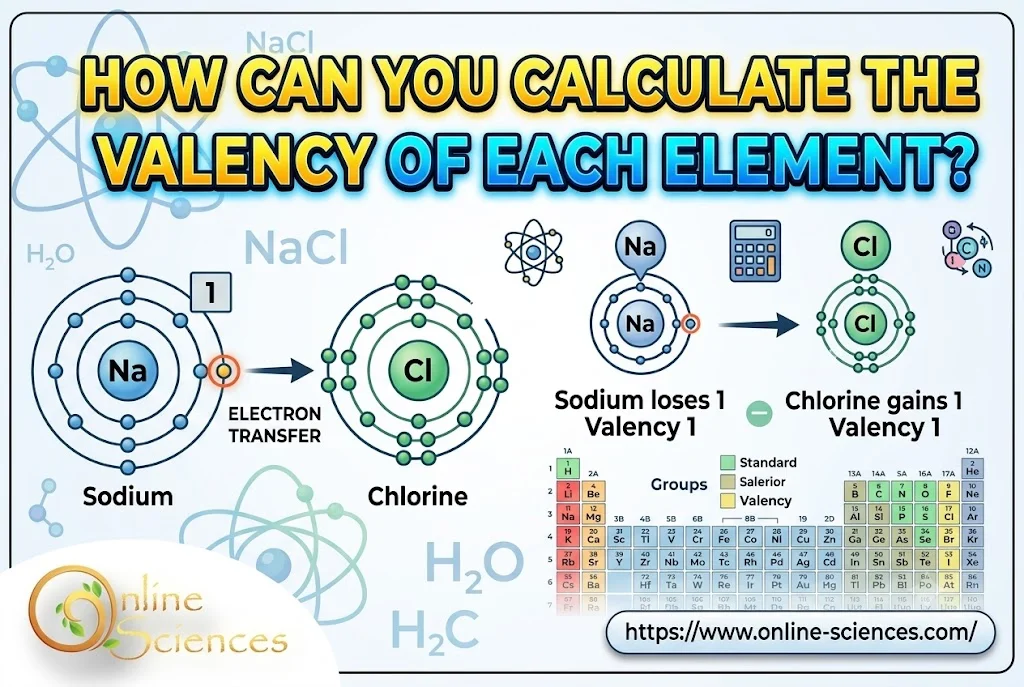
The valency is the number of electrons that an atom gains, loses, or shares during a chemical reaction. The valency is the number of electrons that an atom needs to gain or lose to achieve a noble gas electronic configuration.
The valency of elements
The valency
Valency is a measure of the ability of an atom to bond with other atoms, typically determined by the number of electrons an atom needs to gain, lose, or share to achieve a stable electron configuration (usually a full outer shell, or octet rule).
In the chemical reaction, the atoms try to reach the stable state by losing their outermost electrons (as in the case of metals) or by sharing a number of electrons with other atoms (as in the case of nonmetals).
The valency of the elements or the ions to write the chemical formula of a compound. Chlorine has a valency of 1 as it needs to gain 1 electron to achieve a noble gas electronic configuration.
The atoms try to reach the stable state by gaining a number of electrons to complete the outer shell by (8) electrons (as in the case of nonmetals).
How to find valency
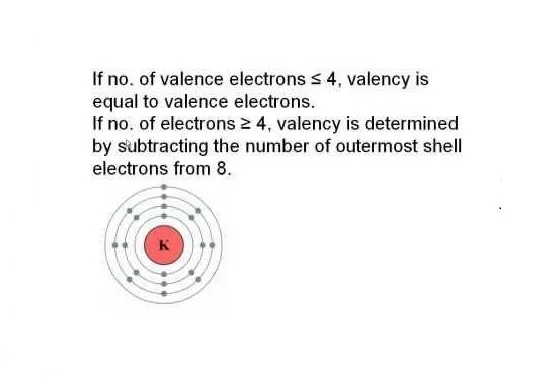
The outermost electrons of an atom determine its valency. The valency of an element measures its ability to combine with other elements. The valency is determined by the number of electrons in the outer shell of each atom of an element.
The valency of some elements in the modern periodic table
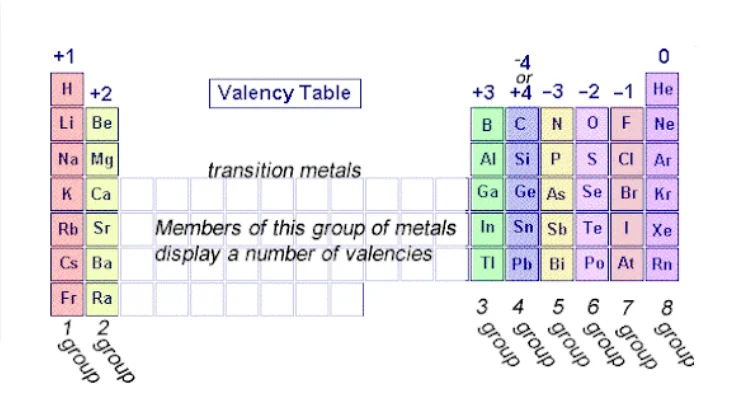
The elements in group (1A) in the modern periodic table have one valence electron in their outer shell; they are very active, and they are mono-valent elements as they have only one electron in their outermost energy levels.
The valency of elements in the periodic table
The valency of the alkaline earth metals in group (2 A) is divalent; they are divalent elements as they have two electrons in their outermost energy levels.
The elements of group (7A) are mono-valent elements as their outermost energy levels have (7) electrons. The elements in group (18) in the modern periodic table are the noble gases that have a valence of zero as the valence shell is saturated with 8 electrons.
To determine the valency of the ionic molecule phosphorus tetraoxide (PO4, four atoms of oxygen, and one atom of phosphorus) you should multiply the total valency of the four oxygen atoms (valency 2) and subtract that from the valency of the phosphorus atom (valency 5). That reveals the valency of (PO4) is 3.
The valency of an element is always a whole number, and some elements exhibit more than one valency, they have more than one valency such as sulphur (S) is divalent, tetravalent, and hexavalent.
Nitrogen (N) is trivalent and pentavalent, while phosphorus (P) is trivalent and pentavalent. The valency of copper I is monovalent, while the valency of copper II is divalent.
The valency of Iron [II] sulfate or ferrous sulfate is divalent as in FeSO4, and the valency of iron is two, while the valency of Iron [III] sulfate or ferric sulfate is trivalent as in Fe2(SO4)3, the valency of iron is three.
How to find valency
1. Determine the Atomic Number
The atomic number gives the number of protons in an atom and, for neutral atoms, equals the number of electrons. This is essential because valency is related to the number of electrons in the outer shell.
2. Write the Electron Configuration
Distribute the electrons in the shells according to the 2n² rule, where:
- The first shell (K-shell) can hold up to 2 electrons.
- The second shell (L-shell) can hold up to 8 electrons.
- The third shell (M-shell) can hold up to 18 electrons, but for most elements, it follows the octet rule (up to 8 electrons in the outer shell).
For example, the electron configuration of carbon (atomic number 6) is 2, 4, meaning there are 2 electrons in the first shell and 4 in the second shell.
3. Identify the Number of Electrons in the Outermost Shell
The number of electrons in the outermost shell determines how an atom will react to achieve a full outer shell. These electrons are called valence electrons.
- If the number of valence electrons is less than or equal to 4, the element tends to lose electrons to achieve stability.
- If the number of valence electrons is greater than 4, the element tends to gain or share electrons.
4. Calculate Valency
For elements with 1 to 4 valence electrons (e.g., hydrogen, lithium, carbon), the valency is equal to the number of valence electrons.
For elements with more than 4 valence electrons (e.g., oxygen, chlorine), the valency is equal to 8−valence electrons8−valence electrons, since they tend to gain electrons to fill their outer shell.
Valency of Common Elements
- Hydrogen (H): Atomic number 1, electron configuration 1 → 1 valence electron → Valency = 1
- Helium (He): Atomic number 2, electron configuration 2 → Full outer shell → Valency = 0 (inert gas)
- Carbon (C): Atomic number 6, electron configuration 2, 4 → 4 valence electrons → Valency = 4
- Oxygen (O): Atomic number 8, electron configuration 2, 6 → 6 valence electrons → Valency = 8 – 6 = 2
- Sodium (Na) has an atomic number of 11, electron configuration is 2, 8, 1 → 1 valence electron → Valency = 1
- Chlorine (Cl) has an atomic number of 17, electron configuration is 2, 8, 7 → 7 valence electrons → Valency = 8 – 7 = 1
Transition metals can have more than one valency due to their d-electrons. For example, iron can have a valency of 2 or 3. Inert (noble) gases like helium, neon, and argon have full outer electron shells and thus have a valency of 0 since they do not typically react or form bonds.
General method for calculating the valency of elements
- For elements with 1-4 valence electrons, Valency = Number of valence electrons.
- For elements with 5-7 valence electrons, Valency = 8 – Number of valence electrons.
FAQ about the Valency of Elements
What is valency in chemistry?
Valency is the combining capacity of an atom. It represents the number of electrons an atom can lose, gain, or share during chemical bonding to achieve a stable outer electron shell (usually the octet rule).
Why is valency important?
Valency is important because it helps predict how elements combine to form compounds, determines chemical formulas, and explains the formation of chemical bonds between atoms.
How can you calculate the valency of an element?
To calculate the valency of an element:
- If the number of valence electrons is 1, 2, or 3, the valency is usually the same as that number.
- If the number of valence electrons is 4, the valency is 4 (can share 4 electrons).
- If the number of valence electrons is 5, 6, or 7, the valency is 8 − (number of valence electrons).
- Noble gases with 8 valence electrons have valency 0 because they are chemically inert.
How do you find the number of valence electrons of an element?
You can find the number of valence electrons from the periodic table: For main group elements, the group number indicates the number of valence electrons.
- Group 1 → 1 valence electron
- Group 2 → 2 valence electrons
- Group 13 → 3 valence electrons
- Group 14 → 4 valence electrons
- Group 15 → 5 valence electrons
- Group 16 → 6 valence electrons
- Group 17 → 7 valence electrons
- Group 18 → 8 valence electrons (except helium = 2)
Can an element have more than one valency?
Yes, some elements show variable valency. For example:
- Iron (Fe) can have valency 2 or 3
- Copper (Cu) can have valency 1 or 2
This happens because atoms can lose different numbers of electrons in different chemical reactions.
What is the valency of metals and non-metals?
- Metals usually have low valency (1, 2, or 3) because they tend to lose electrons.
- Non-metals usually have higher valency (3, 4, 5, or 6) because they tend to gain or share electrons.
How is valency different from oxidation number?
Valency is the combining capacity of an atom, while the oxidation number indicates the charge an atom appears to have in a compound. Valency is always a whole number and has no sign, but oxidation number can be positive, negative, or zero.
What is the valency of common elements?
Some common examples:
- Hydrogen (H) → 1
- Oxygen (O) → 2
- Nitrogen (N) → 3
- Carbon (C) → 4
- Chlorine (Cl) → 1
- Neon (Ne) → 0
How does the octet rule relate to valency?
The octet rule states that atoms tend to combine in a way that gives them 8 electrons in their outermost shell. Valency represents how many electrons an atom must lose, gain, or share to complete its octet (or duet for hydrogen and helium).
Can valency be zero?
Yes. Noble gases have valency 0 because they already have a complete outer shell and do not usually take part in chemical reactions.
Shocking Facts About the Valency of Elements 2026
1. Valency Is Not Always a Fixed Number
One of the most surprising facts about the valency of elements is that it is not always constant. While many elements have a common valency, transition metals such as iron, copper, and chromium can exhibit multiple valencies depending on the chemical compound they form. This ability allows them to participate in a wide variety of chemical reactions.
2. Noble Gases Are Not Always Completely Inactive
For many years, noble gases were believed to have a valency of zero because they rarely react with other elements. However, scientists discovered that heavier noble gases such as xenon and krypton can form compounds under special conditions. This discovery changed our understanding of chemical bonding and showed that even the most stable elements can react.
3. Valency Determines How Compounds Are Formed
The valency of an element controls the number of atoms it can bond with. For example, carbon has a valency of four, allowing it to form millions of different organic compounds. This unique property makes carbon the foundation of all known life on Earth and the basis of modern organic chemistry.
4. The Same Element Can Have Different Oxidation States
Many students confuse valency with oxidation state, but they are not the same. An element may display different oxidation states in different compounds, while its valency refers to its combining capacity. Understanding this distinction is essential for balancing chemical equations and predicting reaction products.
5. Valency Helps Scientists Design New Materials
Modern materials science relies heavily on valency. Researchers use the bonding behavior of elements to create advanced semiconductors, stronger alloys, batteries, and nanomaterials. In 2026, innovations in electronics, renewable energy, and medical technology continue to depend on a deep understanding of elemental valency.
6. Some Elements Break the “Simple Rules”
Although introductory chemistry teaches simple valency rules, many elements do not always follow them. Elements in the transition metal group often form complex ions with different valencies, making chemistry more fascinating than it first appears. This is why advanced chemistry introduces concepts beyond basic valency.
7. Valency Explains Why Water Has the Formula H₂O
Hydrogen has a valency of one, while oxygen has a valency of two. Because of these combining capacities, two hydrogen atoms bond with one oxygen atom to form water (H₂O). Similar valency rules explain the formulas of countless compounds found in nature and industry.
8. Understanding Valency Makes Chemistry Much Easier
Learning valency is one of the fastest ways to improve your chemistry skills. Once you understand how atoms combine, writing chemical formulas, naming compounds, balancing equations, and predicting reactions become much simpler. That’s why valency is considered one of the most important concepts in chemistry education.
9. Valency Plays a Critical Role in Everyday Life
From table salt and fertilizers to medicines, plastics, and electronic devices, the products we use every day exist because atoms combine according to their valencies. Without this fundamental chemical principle, modern technology and daily life would not be possible.
10. Valency Remains a Foundation of Modern Chemistry in 2026
Despite advances in computational chemistry and artificial intelligence, valency remains a core concept for understanding chemical bonding. Scientists, engineers, pharmacists, and students continue to rely on valency to predict chemical behavior, develop new compounds, and solve real-world scientific challenges. In 2026, it remains one of the first and most essential topics taught in chemistry because it forms the basis for understanding how matter interacts.
You can follow Science Online on YouTube from this link: Science Online
What is Valency? Valencies of some metallic, nonmetallic elements & atomic groups
Modern periodic table and classification of Elements
The quantum numbers and principles of distributing electrons
Metallic & nonmetallic properties, Acidic & basic properties in the periodic table
Theories explaining the covalent bond, Octet rule & Overlapped orbitals concept




It helped me a lot i can now understand what valency is
Thank you very much for your comment
it helped me a lot…………you are doing very good for students keep it up…………..thanks a lot!!!
You are welcome
Thank you very much for your comment
thank you so much.. i can clearly understand about valency now…
You are welcome
Thank you very much for your comment
This helped to understand the valency.good efforts.
Thank you very much for your comment
its help very much
thanking you heartfully
You are welcome
Thank you very much for your comment
P+O2 =P2O3O
Number of atoms of reactants must equal number of atoms of products
4P + 3O2 = 2P2O3
How valency and reaction done.
4P + 3O2 = 2P2O3
Number of atoms of reactants must equal number of atoms of products
Can you explain me haber process
You can read this article about Preparation of ammonia gas in industry ( Haber-Bosch’s method )
The most famous elements in 5A group ( Nitrogen properties , Preparation & compounds )
baie dankie
This article really helped me …thanks
Cover more and more topics under your articles ..
You are welcome