
7 Powerful Facts About the Structure and Function of the Ovum in the Female Reproductive System
Structure and Function of the Ovum in the Female Reproductive System is one of the most important topics in human biology and reproduction. The ovum, or egg cell, is the female reproductive cell responsible for creating new life after fertilization. Understanding its structure, protective layers, and vital functions helps students, educators, and healthcare professionals gain a deeper understanding of human reproduction and fertility.
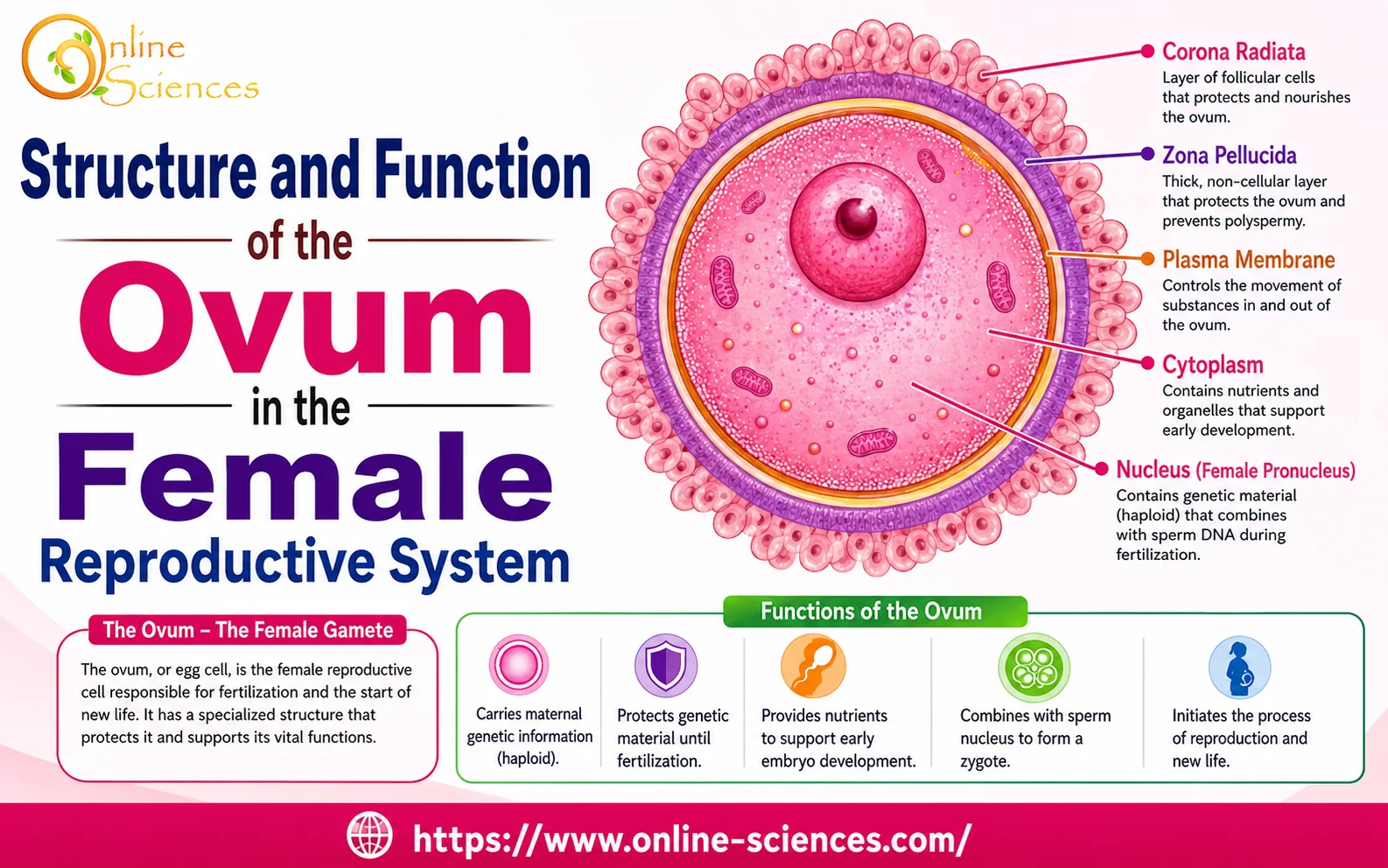
Structure and Function of the Ovum in the Female Reproductive System
Ovum
The ovum (the egg cell) is the female reproductive cell in the female reproductive system, It is large (as sesame seed size) due to the storage of the nutrient materials.
The ovum, also known as the egg cell, is the female reproductive cell that plays a critical role in sexual reproduction. It is one of the largest cells in the human body, measuring about 0.12 millimeters in diameter, large enough to be seen with the naked eye.
Ova develop within the ovaries from precursor cells called oogonia. These oogonia undergo meiosis, a cell division process that results in the formation of mature ova, each containing half the number of chromosomes as the original cell.
Ovulation, the release of a mature ovum from the ovary, typically occurs once a month during a woman’s menstrual cycle. The ovum is then captured by the fallopian tube where fertilization by a sperm can take place.
If fertilization does not occur, the ovum degenerates and is shed along with the uterine lining during menstruation. If fertilization occurs, the ovum fuses with a sperm cell, initiating a series of rapid cell divisions and development into an embryo.
The function of the ovum is to carry the set of chromosomes contributed by the female and it creates the right environment to enable the fertilization by the sperm. The ova provides the nutrients for the growing embryo until it sinks into the uterus and the placenta takes over.
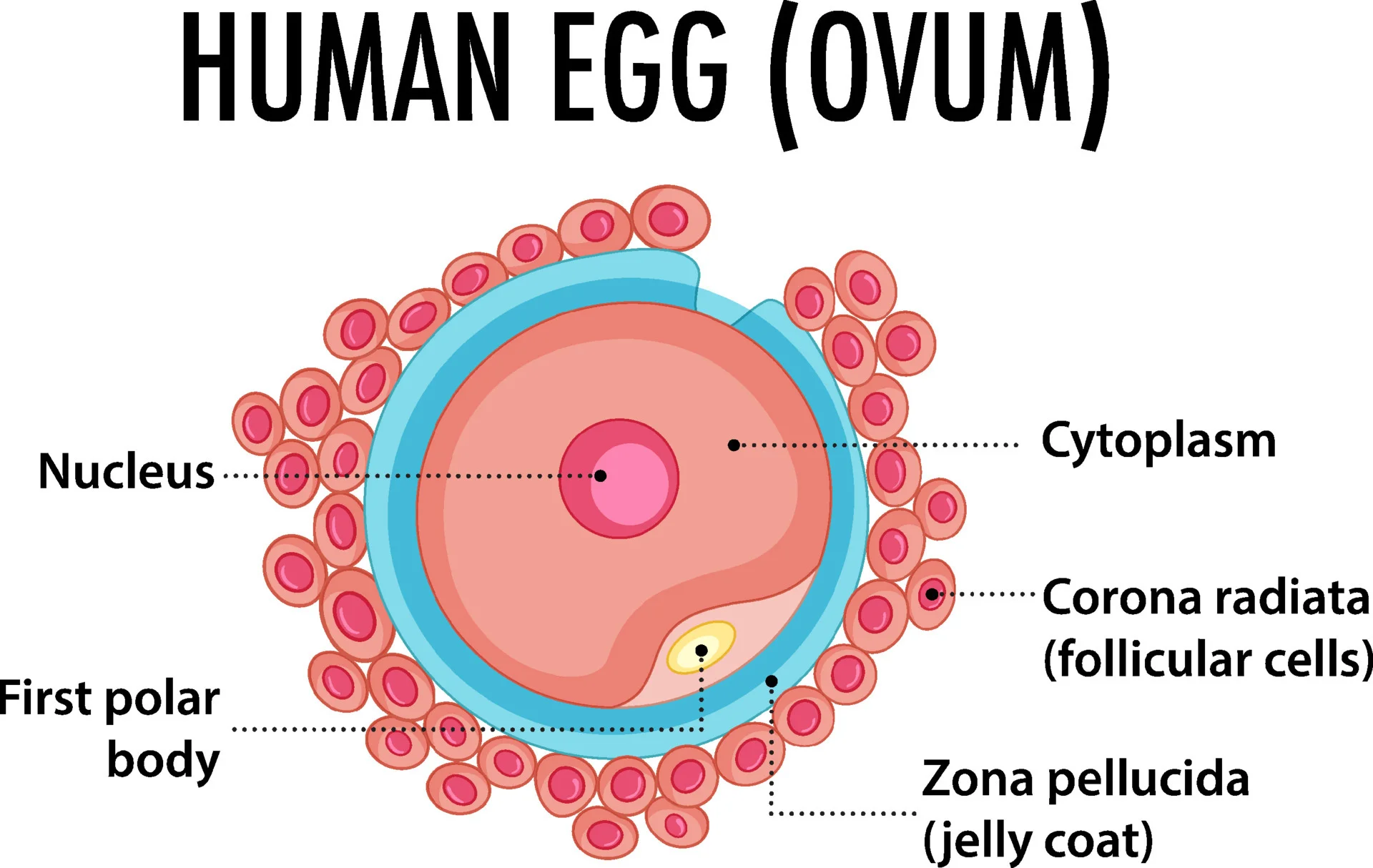
Structure of the ovum
Structure of the ovum
The ovum is not capable of active movement, and it is much larger than the sperm cells. When the ovum joins with the sperm during fertilization, a diploid cell (the zygote) is formed, and the embryo is formed, which gradually grows into a new organism.
The ovum is a spherical cell and not mobile (static). It is one of the largest cells in the human body; it is visible to the naked eye without the aid of a microscope or other magnification device, and it is approximately 0.12 mm in diameter.
The ovum consists of the nucleus, the cytoplasm, and the cellular membrane (that surrounds the cell from outside), The nucleus contains one-half of the genetic materials (the chromosomes), and the cytoplasm stores the food and nutrients.
The ovum has a complex structure designed to support fertilization and early embryonic development. The ovum has a well-defined structure, each part playing a vital role in its function:
- Nucleus: The nucleus, located in the center of the ovum, contains the female’s genetic information (DNA) in the form of 23 chromosomes. These chromosomes determine half of the offspring’s characteristics.
- Cytoplasm (ooplasm): The cytoplasm surrounds the nucleus and is rich in nutrients and organelles like mitochondria. These nutrients fuel the early development of the embryo after fertilization. Unlike eggs in some other species, human ova are lecithal, meaning they contain a relatively small amount of yolk.
- Zona pellucida: This is a transparent glycoprotein layer surrounding the ovum. It protects the ovum and allows only sperm to penetrate during fertilization.
- Corona radiata: The corona radiata is a layer of follicular cells that surrounds the zona pellucida. These cells help nourish the developing ovum and play a role in sperm egg recognition.
Function of the ovum
The ovum has two main functions in reproduction:
Carrying genetic information: The ovum carries the female’s genetic material (23 chromosomes) which combines with the sperm‘s genetic material (23 chromosomes) during fertilization to create a new organism with a unique set of genes.
Providing nourishment: The cytoplasm of the ovum stores nutrients that are essential for the initial development of the embryo after fertilization. These nutrients sustain the embryo until it implants in the uterus and the placenta takes over the role of nourishment.
Ovum Maturation
Unlike sperm cells, which are continuously produced throughout a male’s life, females are born with a finite number of ova within their ovaries. These ova undergo a maturation process called oogenesis, which begins before birth and continues throughout a woman’s reproductive years.
During each menstrual cycle, one ovum typically matures and is released from the ovary in a process called ovulation. If fertilization occurs, the ovum will develop into an embryo and then a fetus. If fertilization does not take place, the ovum will disintegrate and be shed along with the uterine lining during menstruation.
The ovum (egg cell) in the animals and the plants
The ovary produces the ovum (the egg cell), which is the gamete (sexual reproductive cell) in animals and plants.
The ovum is large because it stores nutrients, it is produced in a few numbers and it is not mobile (static), It contains half the number of chromosomes that are found in female body cells.
FAQ About Structure and Function of the Ovum (Female Reproductive System)
Structure of the Ovum (Egg Cell)
What is the ovum?
The ovum (egg cell) is the female gamete produced by the ovaries. It carries half the genetic material (23 chromosomes) and can be fertilized by a sperm to form a zygote.
What is the structure of the ovum?
The ovum is a large, spherical cell made of:
- Nucleus – contains genetic material.
- Cytoplasm (ooplasm) – rich in nutrients and organelles.
- Cell membrane (oolemma) – regulates entry of substances.
- Zona pellucida – protective glycoprotein layer around the egg.
- Corona radiata – outer layer of follicular cells that nourish and protect the egg.
Why is the ovum larger than the sperm?
The ovum contains abundant cytoplasm and nutrients to support early embryonic development after fertilization, while the sperm is specialized for movement and delivery of DNA.
What is the zona pellucida, and why is it important?
The zona pellucida protects the ovum and helps in species-specific sperm binding. After fertilization, it hardens to prevent polyspermy (entry of more than one sperm).
What is the function of the corona radiata?
The corona radiata nourishes the ovum and helps guide sperm toward the egg during fertilization.
Function of the Ovum
What is the main function of the ovum?
The ovum’s main function is to be fertilized by a sperm and form a zygote, which develops into an embryo.
How does the ovum contribute to the embryo?
The ovum provides:
- Half of the genetic material (maternal chromosomes).
- Cytoplasm, mitochondria, and nutrients.
- Factors needed for early cell division.
Where is the ovum released and fertilized?
The ovum is released from the ovary during ovulation and usually fertilized in the fallopian tube (ampulla).
How long does the ovum survive after ovulation?
The ovum remains viable for 12–24 hours after ovulation. If not fertilized, it degenerates and is shed during menstruation.
What happens to the ovum if fertilization occurs?
If fertilized, the ovum becomes a zygote, begins cell division (cleavage), and travels to the uterus for implantation.
Hormonal & Physiological Aspects
Which hormones control ovum formation and release?
- FSH – stimulates follicle (egg) development.
- LH – triggers ovulation.
- Estrogen & Progesterone – prepare the reproductive system for pregnancy.
How many ova does a female release in her lifetime?
Although females are born with millions of immature ova, only about 400–500 ova are released during the reproductive years.
Can more than one ovum be released at a time?
Yes. Occasionally, two ova are released in one cycle, which can lead to fraternal (non-identical) twins if both are fertilized.
Clinical & Educational FAQs
What factors affect ovum quality?
- Age.
- Hormonal balance.
- Nutrition.
- Smoking and toxins.
- Certain medical conditions (e.g., PCOS).
What is the difference between an ovum and an oocyte?
- Primary/secondary oocyte: immature stages.
- Ovum: fully mature egg (after completion of meiosis II, typically upon fertilization).
You can follow Science Online on YouTube from this link: Science Online
Female reproductive system organs, functions, anatomy, and Histological structure of the uterus
Reproduction, Types of sexual reproduction (Conjugation, Reproduction by sexual gametes)
Reproduction in Human beings, Structure of the male genital system & sperm
Structure of Female genital system & ovum, Oogenesis stages & Menstrual cycle
Fertilization process, Pregnancy, and the stages of embryonic development
Genital system diseases, Structure of ovum and sperm, Fertilization and embryo formation
Structure of Female genital system and ovum, Oogenesis stages and Menstrual cycle
Fertilization process, Pregnancy, and the stages of embryonic development




How can I achieve excellence in my studies
Studies are not enough to achieve excellent , You must watch scientific programs , You should search for new information , you should increase your knowledge by reading articles and books , You should learn from You tube videos , You can ask your teachers about unknown things .