
Robots in the Workplace advantages, disadvantages and applications
Robots in the Workplace offer high accuracy. Robots can be used in chemical industries, chemical spills, nuclear plants, and so on. They help reduce company losses by working in hazardous environmental conditions, such as polluted environments, in the collection and cleaning of radioactive waste. Robots can repeat the tasks any number of times in a day without getting tired.
What are workplace robots?
Workplace robots are more about enabling broader, people-related processes such as observation, monitoring, environmental testing, reporting, collaboration, and remote connection via telepresence, etc. They are designed and built to work for humans, and they are deployed where people work to optimize resources, improve safety/comfort, and increase productivity through workplace augmentation and/or automation.
Advantages of Robots in the Workplace
Robots are cheaper than humans, and their cost is now decreasing. If you run an essay writing service, you can use robots to perform every kind of research related to any subject. Robots are more active and don’t get tired like humans. The collaboration between humans and robots can reduce absenteeism. The pace of humans can’t increase, hence robots are helping humans.
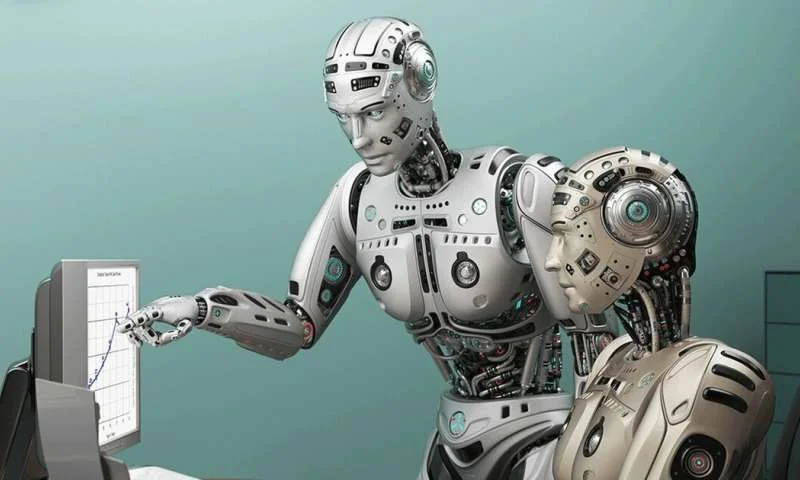
Robots in the Workplace
Robots are stronger & faster than humans, they are more precise than humans, and they don’t tremble or shake like human hands. Robots have smaller and more versatile moving parts that help them in performing tasks with more accuracy than humans. Robots come in any shape and size, depending upon the need of the task.
They can work in any environmental condition whether it is space, underwater, in extreme heat or wind, etc, They can be used everywhere where human safety is a huge concern, they are programmed by humans; they can be used for any dangerous and unwanted work where humans may deny to offer their services, many robotic probes have been sent into space but have never returned.
Robots in warfare have proven to be very successful. They can save more lives. They never get tired and can literally work on certain tasks 24 x 7. The human brain gets tired and requires rest, unlike robots. Robots work on certain tasks without making any mistake which is the best thing about them. They work with a similar velocity the whole day, and unlike human beings, their energy never fades away.
The work is done in collaboration, which reduces the time of the worker by up to 85%. The collaborative robots are deployed in the lightweight task to assist the workers, holding the parts for the operators and applying the fasteners to the manufactured products.
Humans can’t work as fast as robotic machines can. Robots help to save time, and they can perform tasks that are difficult & dangerous for humans. The human body may get hurt, but the robotic machine would certainly not get hurt. They can work with constant speed, So, Robots can easily perform the difficult tasks.
More products are manufactured in less time. Robots can work faster than humans, and this results in more finished products than what could be done manually. They help to increase production, and the production of defective goods decreases, producing similar quality products in less time and with more accuracy.
Robots are flexible in their work. They can work in adverse conditions, but this cannot be done by a human. So, in places where the human has no reach, robots are used, sent, and the task is accomplished. So, they are flexible in every situation.
Disadvantages of Robots in the Workplace
The robots need people for monitoring & supervision, they can’t do everything, Some jobs need to be completed by the human, If your human employees aren’t caught up doing the things that could be left for robots, they’ll be available & productive, They can talk to customers, answer emails & social media comments, help with branding and marketing, and sell products.
Although robots in the workplace can increase efficiency in many businesses, they can increase the unemployment rate, unemployment in the country rises as manual work is reduced and the whole work is performed by Robots. Robots reduce the chances of employment in industries; human labour is no longer required in many factories and manufacturing plants.
The poor labours get no work to do, so, they get poorer, the owners get the work in no time, with increased productivity & more efficiency, making them richer day by day. Robots don’t have a sense of emotions or conscience. They lack empathy. Robots can handle their prescribed tasks, but they can’t handle unexpected situations.
Robots can be a danger. This is because no one can trust a robot, as it does not have a human brain that can think before doing anything. Whatever is fed to the robots through chips is performed if it goes wrong. Once the machine is damaged, the whole company can come into chaos.
The cost of affording robots is very high. Buying robots and robotic machines is not child’s play. Not every company can afford the same, so, the ones that can afford it are a boon for them, but those who can’t buy have to face stiff competition. That lags them behind, getting no place in the market. Maintenance of the machines costs more than their installation, and this can’t be afforded by all companies as the profits are not always raining incessantly.
The financial budget increases than expected, So, it puts the company in great financial issues and leads the company to be bankrupt, which is a huge unbearable loss for any company, the maintenance cost of the robot is high, When the company itself is reeling under the pressure of the financial crisis, then how can the company be expected to maintain the robotic machines, It isn’t possible.
The high cost is needed to train employees with robots, if the robots are ruling the work in many places, labour is needed to assist them, because the whole work can’t be thrown in the ability of the robots, So, the employees need training and that involves cost, So, a lot of money is involved with the installation of machines in the workplace.
If Robots can’t do something for which they are not designed to do, they can produce a lot of electrical waste, and the waste produced by the robots can’t be used anywhere, which is a huge loss. Robots can make people lazy, which is neither good for the company nor for the employees.
Robots come with higher expenses than humans; they may have AI, but they are not as intelligent as humans, They can’t improve their jobs outside the pre-defined programming because they simply can’t think for themselves, Robots installed in workplaces still require manual labour attached to them, Training those employees on how to work with the robots has a cost attached to it.
FAQ About Robots in the Workplace
1. What are workplace robots?
Workplace robots are programmable machines designed to perform tasks in professional environments such as factories, warehouses, hospitals, offices, and farms. They may operate independently or collaborate with humans (collaborative robots or “cobots”).
2. What are the advantages of robots in the workplace?
- Increased Productivity: Robots can work 24/7 without breaks, increasing output and efficiency.
- Higher Accuracy: They perform repetitive tasks with precision, reducing human error.
- Improved Workplace Safety: Robots handle dangerous jobs such as heavy lifting, chemical exposure, high-temperature environments, and hazardous material handling.
- Cost Savings (Long-Term): Although initial costs are high, robots reduce labor expenses and operational mistakes over time.
- Consistent Quality: Automation ensures uniform product quality in manufacturing.
3. What are the disadvantages of robots in the workplace?
- Job Displacement: Some repetitive and manual jobs may be replaced by automation.
- High Initial Investment: Purchasing, programming, and maintaining robots is expensive.
- Technical Failures: System errors can interrupt workflow and cause downtime.
- Limited Creativity: Robots cannot replace human creativity, emotional intelligence, or complex decision-making.
- Cybersecurity Risks: Connected robotic systems may be vulnerable to hacking.
4. What are the main applications of robots in the workplace?
- Manufacturing: Assembly lines, Welding, Packaging, and Quality inspection.
- Logistics & Warehousing: Inventory management, Autonomous delivery systems, Sorting and packing.
- Healthcare: Robotic surgery, Patient assistance, Medication delivery.
- Agriculture: Automated harvesting, Crop monitoring, and precision farming.
- Offices & Services: Reception robots, Cleaning robots and Customer service automation.
5. How do robots improve employee safety?
Robots reduce exposure to toxic chemicals, heavy machinery accidents, repetitive strain injuries, and extreme temperatures. This lowers workplace injury rates.
6. Do robots completely replace human workers?
No. In most industries, robots complement human workers rather than replace them entirely. Humans are still needed for supervision, programming, maintenance, creativity, and decision-making.
7. What skills are needed in a robotic workplace?
As automation increases, demand grows for:
- Robotics engineering.
- AI programming.
- Data analysis.
- System maintenance.
- Cybersecurity.
8. Are robots good for businesses?
Yes, when implemented properly. They increase productivity, improve safety, and maintain consistent quality. However, businesses must balance automation with workforce planning and ethical considerations.
Robots in the workplace offer major advantages such as efficiency, precision, and safety. However, they also present challenges, including job displacement and high costs. The future of work will likely involve collaboration between humans and intelligent machines rather than full replacement.
You can subscribe to Science Online on YouTube from this link: Science Online
Workplace robotics safety, Workplace Robot types, importance & dangers
Types, uses and importance of Robots in the Workplace
Advantages and disadvantages of using robots in our life
Industrial robot (Auto industry) uses, advantages and disadvantages
Army robots types, advantages, disadvantages & how do Artificial soldiers change the future of war?
Artificial intelligence in medical field advantages & how AI medical diagnosis changes medicine
Artificial intelligence in pharmacy, and will pharmacists be replaced by robots?
Rescue robots (Mobile robots) types, uses, advantages and disadvantages
Collaborative robots, Universal Robots UR3 importance, uses, advantages and disadvantages