Ultimate Robots Types 2026 Guide: Powerful Humanoid, Military, Industrial & Nano Robots Revolution
There are many Robots types, Robots can be used in the manufacturing industry, the military, space exploration, transportation, and medical applications, The robot is a reprogrammable, multifunctional manipulator that is designed to move things with the help of variable programmed motions, Reprogrammable means the robot is controlled through a computer-based program which can be changed at any time, Multi-functional attribute signifies multiple numbers of applications carried out by a robot.
What are Robots?
Robots are programmable machines designed to perform tasks automatically or semi-automatically. Modern robots use sensors, processors, artificial intelligence, and mechanical systems to interact with their environment and complete specific functions.
Robots Types 2026
Artificial Intelligence in Robotics
AI is making robots smarter by enabling:
- Autonomous decision-making.
- Voice communication.
- Facial recognition.
- Machine learning adaptation.
- Human interaction.
- Real-time navigation.
Modern AI robots can learn from experience and improve performance over time.
The Future of Robotics in 2026
The future of robotics includes:
- Fully autonomous humanoid assistants.
- AI-powered healthcare robots.
- Smart military defense systems.
- Advanced robotic surgery.
- Household service robots.
- Self-learning in industrial automation.
- Swarm nano-robotics.
Experts believe robotics will continue transforming healthcare, transportation, education, manufacturing, and smart cities over the next decade.
Types of Robots
Robots are used in education, They are used at home or in classrooms, They come with hands-on programmable sets, 3D printers with lesson plans, and even teacher robots like EMYS, Robots can be used in entertainment, They are designed to evoke emotional responses and make us laugh or feel surprised or in awe, Medical robots are used in medicine and medical institutions, such as surgery robots.
Robots are machines that can perform tasks automatically, either programmed in advance or by responding to their environment. They come in all shapes and sizes and can be used for a wide variety of purposes.
Robots are used in manufacturing, healthcare, and other industries. They can sense their environment and take action. They can be pre-programmed to perform a specific task or be intelligent enough to adapt to new situations. There are many different types of robots, each with its unique capabilities.
Consumer robots are the robots you can buy and use just for fun or they can be used to help you with tasks and chores, Robots are used in universities and corporate research labs, they can be called research robots, these robots can do useful things, they’re used to help researchers to research well, Underwater robots are used in the water, and they consist of deep-sea submersibles.
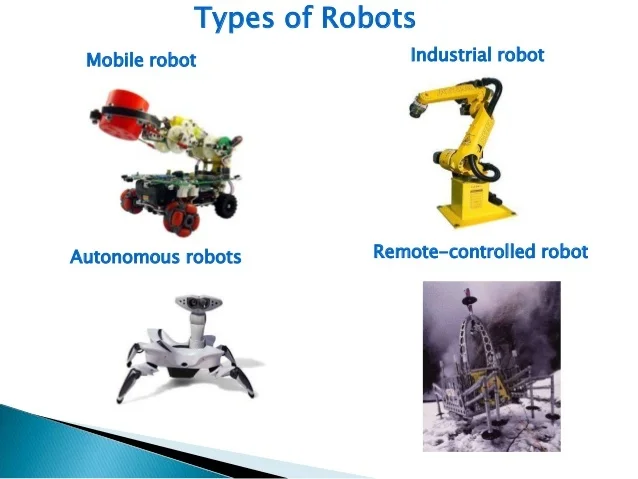
Robots types
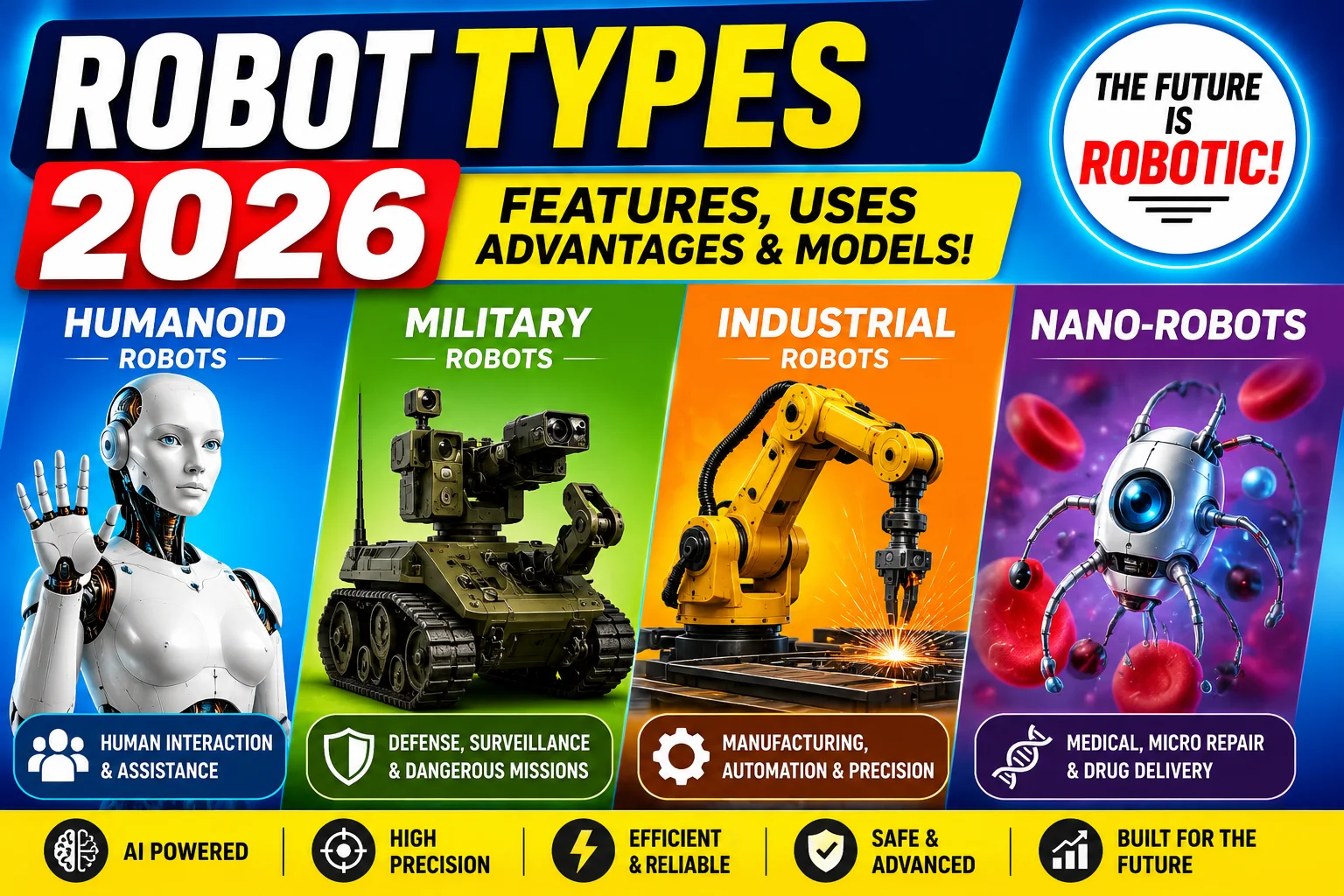
Robots Types 2026: The Future of Smart Robotics Technology
Robotics technology is advancing rapidly in 2026, transforming industries, healthcare, military systems, manufacturing, and daily life. Artificial intelligence, machine learning, and automation are helping modern robots become smarter, faster, and more independent than ever before.
Today’s robots can perform dangerous industrial work, assist doctors during surgeries, patrol military zones, and even interact socially with humans. From humanoid robots to microscopic nano-robots, robotics is becoming one of the most revolutionary technologies shaping the future.
Humanoid Robots
The humanoid robot is a type of robot that replicates the human body. The design of Humanoid robots makes them fairly distinct from the other types of mobile robots. Humanoid robots are designed to resemble humans in appearance, movement, and behavior. They can be used in a variety of applications, such as search and rescue and elder care.
The humanoid robot contains sensors that are among the main components in the humanoid robot and they play a vital role in robotic paradigms. There are two types of sensors, which are Proprioceptive and Exteroceptive sensors. The proprioceptive sensors sense the robot’s orientation, position, and other motor skills, while the exteroceptive sensors include visionary and sound sensors.
The typical humanoid robot consists of a head, two arms, a torso, and two legs, just like a human, but many of those robots are based on some part of the human body, like from the waist up. They are designed to look like people, and they have a mechanical appearance. Humanoid robots are designed to resemble humans in appearance and movement. These robots often include artificial intelligence, facial recognition, speech systems, and human-like interactions.
Features of Humanoid Robots
- Human-like body structure.
- AI-powered communication.
- Facial and voice recognition.
- Autonomous movement.
- Emotional interaction systems.
- Smart sensors and cameras.
Uses of Humanoid Robots
- Customer service.
- Elderly care.
- Education.
- Entertainment.
- Smart home assistance.
- Medical support.
Advantages of Humanoid Robots
- Natural human interaction.
- Ability to assist in social environments.
- Improved customer experience.
- Useful for caregiving and education.
Popular Humanoid Robot Models 2026
- Tesla Optimus.
- Figure 02.
- Ameca.
- Atlas by Boston Dynamics.
- Unitree H1.
Military robots
Military robots can be used in military purposes such as law enforcement, and search and rescue fields, Military robots include bomb disposal robots, different transportation robots and reconnaissance drones, they include ground systems like Endeavor Robotics’ PackBot, They are used to scout for improvised explosive devices, and BigDog, They are designed to assist troops in carrying heavy gear, Security robots come with autonomous mobile systems such as Cobalt.
Disaster response robots can perform dangerous jobs such as searching for survivors in the aftermath of an emergency. Drones are known as unmanned aerial vehicles. They come in different sizes and have different levels of autonomy, such as DJI’s popular Phantom series and Parrot’s Anafi, as well as military systems like Global Hawk, used for long-duration surveillance.
Aerial robots (drones) are robots that can fly in the air. Drones are used for a variety of purposes, including photography, videography, and delivery. Drones are becoming increasingly popular for commercial and recreational use. Military robots are used for a variety of military applications, such as reconnaissance, bomb disposal, and combat. Military robots are designed for defense, surveillance, bomb disposal, combat support, and dangerous missions.
Features of Military Robots
- Autonomous navigation.
- Thermal imaging systems.
- AI-powered target detection.
- Heavy-duty durability.
- Weapon integration capabilities.
- Remote operation systems.
Uses of Military Robots
- Surveillance missions.
- Border security.
- Explosive disposal.
- Reconnaissance operations.
- Search and rescue missions.
- Logistics and supply transport.
Advantages of Military Robots
- Reduce human casualties.
- Operate in dangerous environments.
- Improve mission accuracy.
- Increase operational efficiency.
Popular Military Robot Models 2026
- Ghost Robotics Vision 60.
- DOGO Tactical Robot.
- Milrem THeMIS.
- MAARS Robot.
- Guardium UGV.
Industrial robots
The industrial robot arm can be used in the factory environment for manufacturing applications. Industrial robots can be classified according to different specifications, such as type of movement (degrees of freedom), application (manufacturing process), architecture (serial or parallel), and brand. There is a new qualifier for industrial robots that can be collaborative or not.
Robots are created with specific applications or processes, Different applications will have different requirements, The painting robot will require a small payload but a large movement range, The assembly robot will have a small workspace but will be very precise and fast, Depending on the target application, the industrial robot will have a specific type of movement, linkage dimension, control law, software, and accessory packages.
They are articulated arms specifically developed for such applications as welding, material handling, painting, and others. They are used in an industrial manufacturing environment. There are many industrial robot brands, and there are many robots for different applications and in different sizes. The smallest companies usually target a specific size or application range.
Industrial robots are the most common type of robot. They are the workhorses of the manufacturing industry. They are used in factories to perform repetitive tasks such as welding, painting, and assembly. Industrial robots are very large and powerful, and they are stationary and bolted down to the factory floor. Industrial robots are widely used in factories and manufacturing plants for automation and precision work.
Features of Industrial Robots
- High-speed operation.
- Precision manufacturing.
- AI automation systems.
- Robotic arms.
- Continuous operation.
- Heavy load handling.
Uses of Industrial Robots
- Car manufacturing.
- Electronics assembly.
- Packaging systems.
- Welding.
- Painting.
- Warehouse automation.
Advantages of Industrial Robots
- Increased productivity.
- Reduced manufacturing costs.
- Improved accuracy.
- Enhanced workplace safety.
- 24/7 operation capability.
Popular Industrial Robot Models 2026
- FANUC CRX Series.
- ABB YuMi.
- KUKA KR Quantec.
- Universal Robots UR20.
- Yaskawa Motoman.
Collaborative industrial robots
Collaborative robots can be used in the same environment as humans, They can be taught instead of programmed by an operator, Collaborative robots are made with safety standards, and they can’t hurt a human, While traditional industrial robots need to be fenced off away from human co-workers for safety reasons, Collaborative robots such as Rethink Robotics Sawyer and Baxter, Universal Robots UR3, UR5 and UR10, ABB Yumi & KUKA LBR IIWA.
Dual-arm robots are composed of two arms that can work together on a given workpiece. The type of movement is dictated by the arrangement of joints (placement and type) and linkages. Serial robots are composed of a series of joints and linkages that go from the base to the robot tool, and they are common robots.
Collaborative robots (cobots) are a newer type of robot that is designed to work safely alongside human workers. Cobots are smaller and more flexible than industrial robots, and they can be used for a wider variety of tasks. They are less powerful than industrial robots, but they can be more versatile and easier to program. This makes them ideal for tasks that require human-robot interaction, such as assembly or product testing.
Redundant robots
Redundant robots can fully position their tool in a given position, but while 6-axis robots can only have one posture for one given tool position, redundant robots can accommodate a given tool position under different postures. This is like the human arm that can hold a fixed handle while moving the shoulder and elbow joints.
Stationary robots
Stationary robots work without changing their positions, “stationary” does not mean that the robot is not moving, and “stationary” means that the base of the robot does not move during operation, Stationary robots can manipulate their environment by controlling the position & orientation of an end-effector, Stationary robot category contains the robotic arms, cartesian robots, cylindrical robots, spherical robots, SCARA robots and parallel robots.
Swarm robots
Swarm robots consist of multiple small robots. These robots structurally do not create a single united robot, but operate as their robot modules operate cooperatively. They are similar to modular robotic systems, but the elements of swarm robots have less functionality, and herd configurations do not create new robots.
Modular robotic systems
Modular robots are similar to swarm robots. They have multiple robots in their configurations. Modules of these systems are more functional compared to the robotic herd. A single module of the modular robotic system can have self-mobility & it can operate alone. The power of modular robotics comes from its versatility in its configurations.
Flying robots
Flying robots are strong and aerodynamically sound robots, they are the most popular robot types, They can maneuver & float on the air using their plane-like or bird/insect-like wings, propellers or balloons, such as airplane robots, bird/insect-inspired wing-flapping robots, propeller based multi-copters and balloon robots, some big companies are planning to incorporate those automated flying machines into their day to day business.
Micro-robots
Microrobots can be used for robots that can handle micrometer-sized components. Microbotics is the field of miniature robotics, they are mobile robots with characteristic dimensions of less than 1 mm, Microbots are tiny robots that can be used for a variety of tasks, such as medical diagnosis and repair, environmental monitoring, and scientific research.
Micro-robots term is used to specify both robots that have dimensions on a micrometer scale and robots that can operate on micrometer resolution, So, both possibly very big stationary robots that can manipulate their environment on a micrometer scale, and small robots that are measured by micrometers are called micro motors.
Nano-Robots
Similar to micro-robots, nano-robots are also defined a bit vaguely. The term “nano-robot” refers to both very small robots with nanometer-scale dimensions and robots that can manipulate their environment with nanometer-scale resolution, regardless of their actual size. Nano-robots are microscopic robots designed to operate at the molecular or cellular level.
Features of Nano-Robots
- Extremely small size.
- Precision targeting systems.
- Medical compatibility.
- Advanced molecular control.
- Smart drug delivery systems.
Uses of Nano-Robots
- Cancer treatment.
- Drug delivery.
- Bloodstream monitoring.
- Tissue repair.
- Medical diagnostics.
- Environmental cleanup.
Advantages of Nano-Robots
- Highly precise medical treatments.
- Minimal surgical damage.
- Faster diagnosis.
- Advanced healthcare applications.
Nano-Robot Models and Research 2026
- DNA-based nano-bots.
- Magnetic nano-swimmers.
- Medical nano-carriers.
- Biohybrid nano-machines
Telepresence robots
Telepresence robots help you to be present at a place without actually going there, You can log on to the robot avatar via the internet & drive it around, Telepresence robots can see and talk with people, Employees can use them to collaborate with colleagues from a distant office, and doctors can use them to check on patients.
Space robots
Aerospace robots include all sorts of flying robots, the SmartBird robotic seagull and the Raven surveillance drone, Also robots that can operate in space, such as Mars rovers and NASA’s Robonaut, There are many space robots such as robots used on the International Space Station, Canadarm that was used in Shuttles, as well as Mars rovers and other robots used in space.
Domestic robots
Domestic or household robots are used at home, They are used for household tasks, such as vacuuming and mowing the lawn. They include many different devices such as robotic vacuum cleaners, robotic pool cleaners, sweepers, gutter cleaners and other robots that can do many chores, some surveillance and telepresence robots can be used as household robots if they are used in that environment.
Soft elastic robots
Soft/elastic robots are new introductions to robotics. They are bio-inspired, Most applications are inspired by squids or inchworms, both structurally and functionally.
Exoskeletons robots
Robotic exoskeletons can be used for physical rehabilitation and for enabling a paralyzed patient to walk again. Some have industrial or military applications, by giving the wearer added mobility, endurance, or capacity to carry heavy loads.
Murata girl robot
Murata girl or Murata Seiko-chan robot is a type of compact robot that can come in handy in extremely crowded areas. It is a unicycle robot manufactured by the Japanese electronics company Murata. According to the company, she has advanced gyro sensors that enable her to stabilize, a Bluetooth device for communication, and an ultrasonic sensor for target detection.
Agricultural Robots
Agricultural Robots are used in agriculture to automate tasks such as planting, weeding, and harvesting crops. Agricultural robots can help to increase yields and reduce labor costs.
Autonomous mobile robots (AMRs)
Autonomous mobile robots (AMRs) can move around their environment without human intervention. AMRs are used in warehouses and logistics centers to transport goods.
Underwater Robots
Underwater Robots (AUVs) can operate underwater. They can be used for a variety of purposes, including oceanography, search and rescue, and oil exploration. AUVs can be autonomous or controlled by a human operator.
Service Robots
Service Robots are designed to perform tasks that would otherwise be done by humans. They can be found in a variety of settings, including hospitals, homes, and businesses. Some common examples of service robots include vacuum cleaners, lawn mowers, and delivery robots. They are used in a variety of applications, such as cleaning, healthcare, logistics, retail, delivering goods, and providing customer service. Service robots can perform tasks in non-manufacturing settings. Some examples of service robots include:
- Medical robots can be used to perform surgery, assist with rehabilitation, or provide companionship to patients. Medical robots can help surgeons perform procedures with greater precision and control, and they can be used to provide therapy to patients who are recovering from injuries or illnesses.
- Logistics robots are used in warehouses and distribution centers to move and store goods. They can automate tasks such as picking, packing, and shipping goods. Logistics robots can help to improve efficiency and accuracy in the supply chain.
- Retail robots can be used to stock shelves, answer customer questions, or provide security.
Advantages of Robots in 2026
Robots offer many benefits across industries:
- Increased productivity.
- Improved workplace safety.
- Faster operations.
- Better precision and accuracy.
- Reduced labor costs.
- 24-hour continuous work.
- Advanced AI decision-making.
- Assistance in dangerous environments.
Disadvantages of Robots
Despite their advantages, robots also present challenges:
- High development costs.
- Possible job displacement.
- Cybersecurity risks.
- Ethical concerns.
- Dependence on technology.
FAQ – Types of Robots
What are the main types of robots?
The main types include industrial robots, service robots, humanoid robots, medical robots, military robots, educational robots, and autonomous robots.
What are industrial robots used for?
Industrial robots are used in factories for tasks like assembly, welding, painting, packaging, and quality inspection.
What is a service robot?
A service robot helps people in daily life or business tasks such as cleaning, delivery, customer service, and hospitality.
What are humanoid robots?
Humanoid robots are robots designed to look and move like humans and interact with people using speech, gestures, and facial expressions.
What are medical robots used for?
Medical robots assist in surgery, rehabilitation, patient care, hospital logistics, and medical training.
What are autonomous robots?
Autonomous robots can navigate and perform tasks on their own without human control, using sensors and AI (e.g., delivery robots, self-driving robots).
What are collaborative robots (cobots)?
Cobots are robots designed to work safely alongside humans in workplaces like factories and labs.
What are educational robots?
Educational robots are used for teaching coding, robotics, and STEM skills, especially for children and students.
What is the difference between industrial robots and service robots?
Industrial robots work mainly in factories and production lines, while service robots assist people in homes, offices, hospitals, and public places.
Which type of robot is most common today?
Industrial robots are the most widely used type, especially in manufacturing and automotive industries.
Conclusion
Robots in 2026 are becoming more intelligent, capable, and integrated into everyday life. Humanoid robots improve human interaction, military robots enhance safety, industrial robots increase manufacturing efficiency, and nano-robots revolutionize medicine. As artificial intelligence and robotics technologies continue advancing, the world is moving toward a future where robots will play a major role in almost every industry and aspect of modern society.
You can subscribe to Science Online on YouTube from this link: Science Online
Advantages and disadvantages of using robots in our life
Robot teachers use, advantages and disadvantages
Automation in manufacturing uses, advantages and disadvantages